Apparel Sourcing in the Shadow of Coronavirus (updated February 2020)

[The situation has been quickly evolving. Please check the updated analysis: How Might Covid-19 Affect Apparel Sourcing and Trade ]

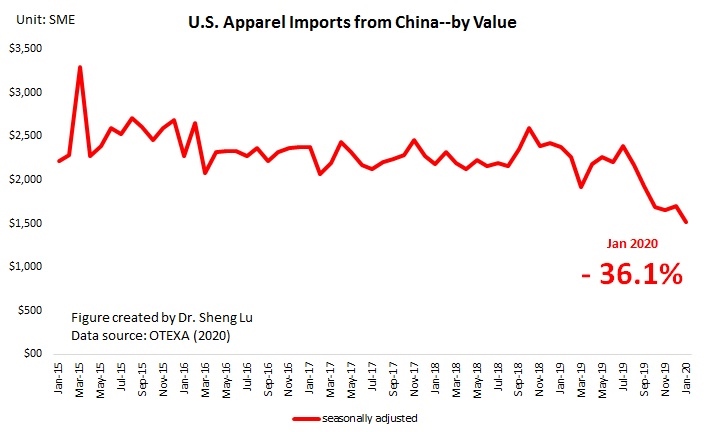
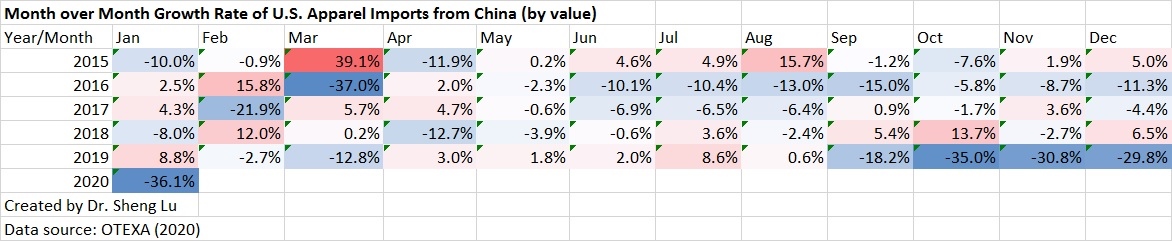
  • The real impact of the coronavirus is yet to come. Western fashion brands and retailers know that sourcing from China is always slow in January and early February because of the Chinese New Year (CNY). Instead, the immediate economic impact of the coronavirus right now is on China’s domestic retail market, as many stores (including well-known clothing and footwear brands) have been closed.
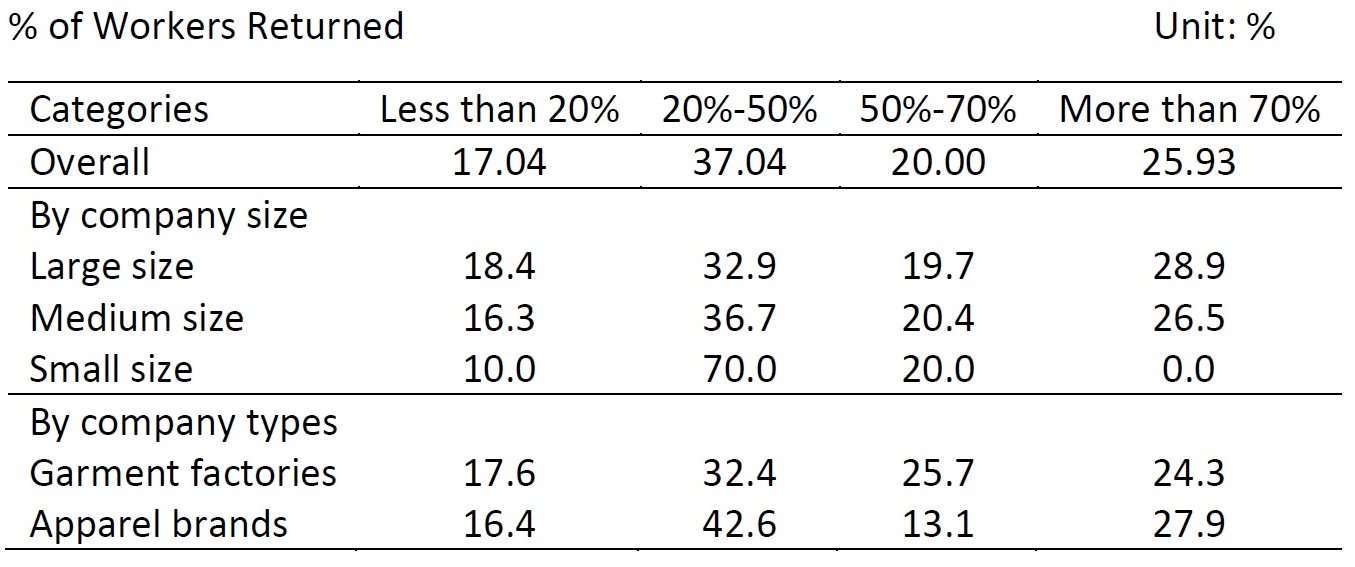
  • As the disease continues to spread quickly, the concerns about the outlook of sourcing from China are growing. Even though factories in China are scheduled to reopen on February 3, according to the latest government announcement, over dozens of major cities in the country have been locked down (encircling roughly 50 million people so far), making it impossible for many workers to return to their job. Further, it is hard to predict how long such an unprecedented large-scale lockdown will last.

1

2

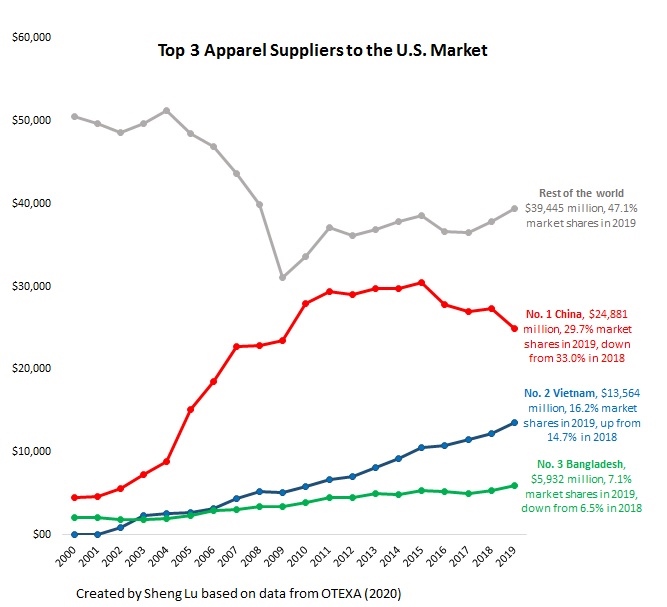
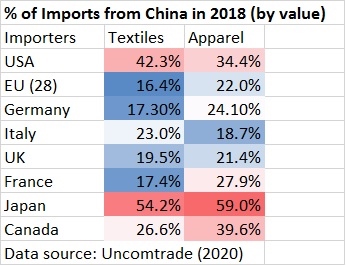
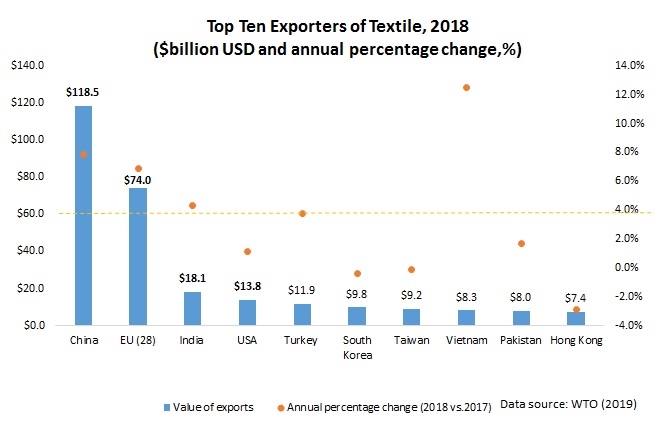
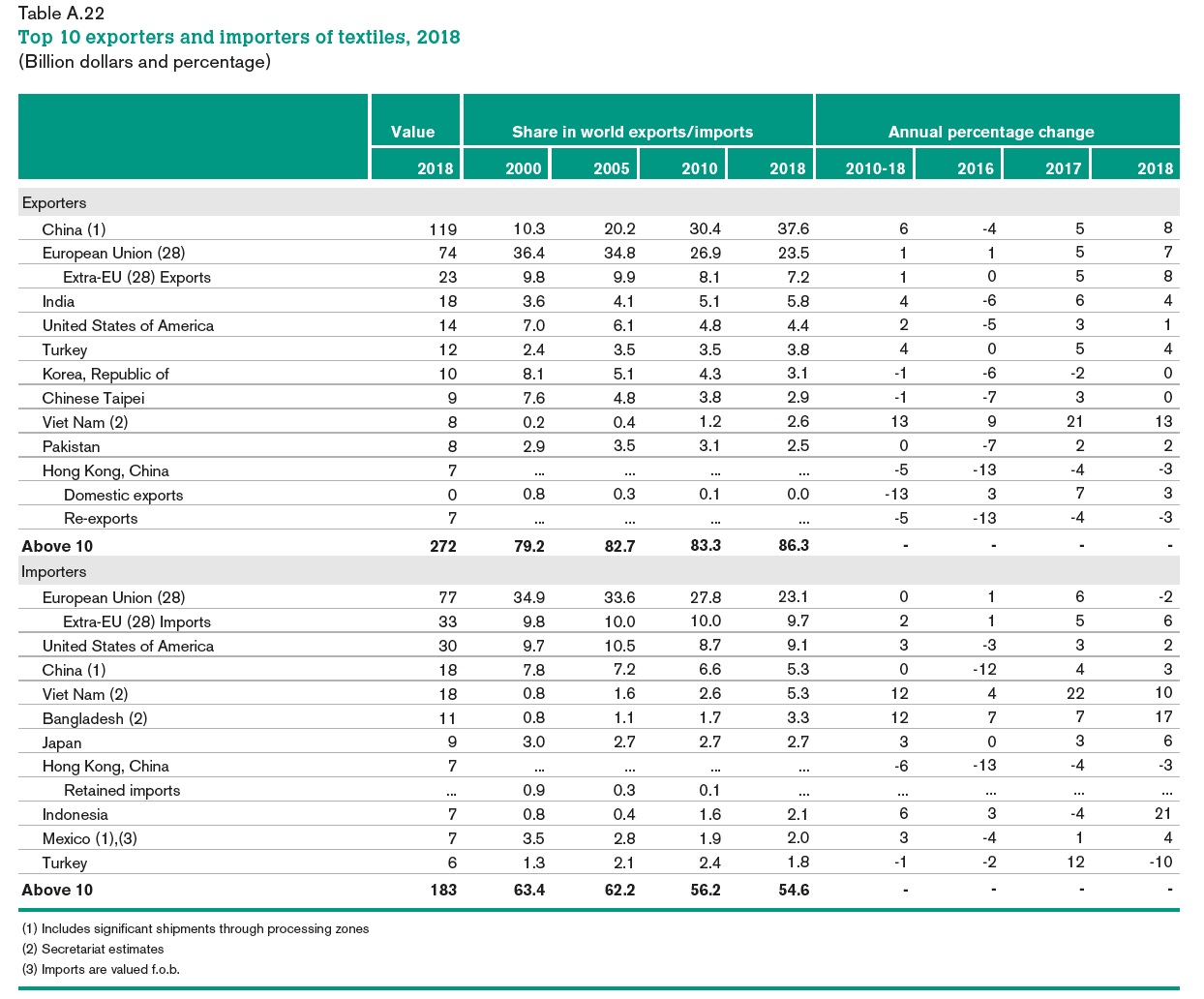
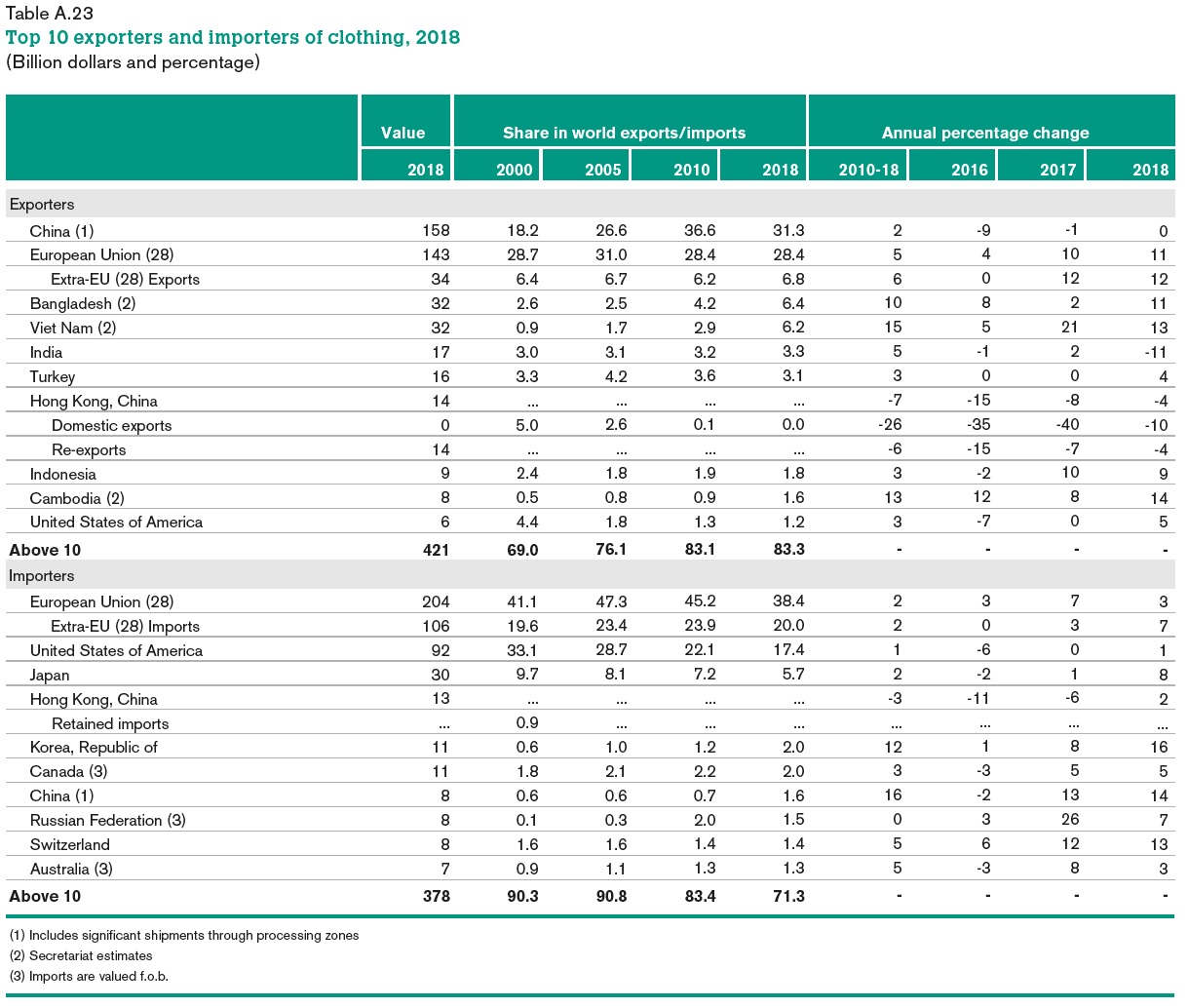
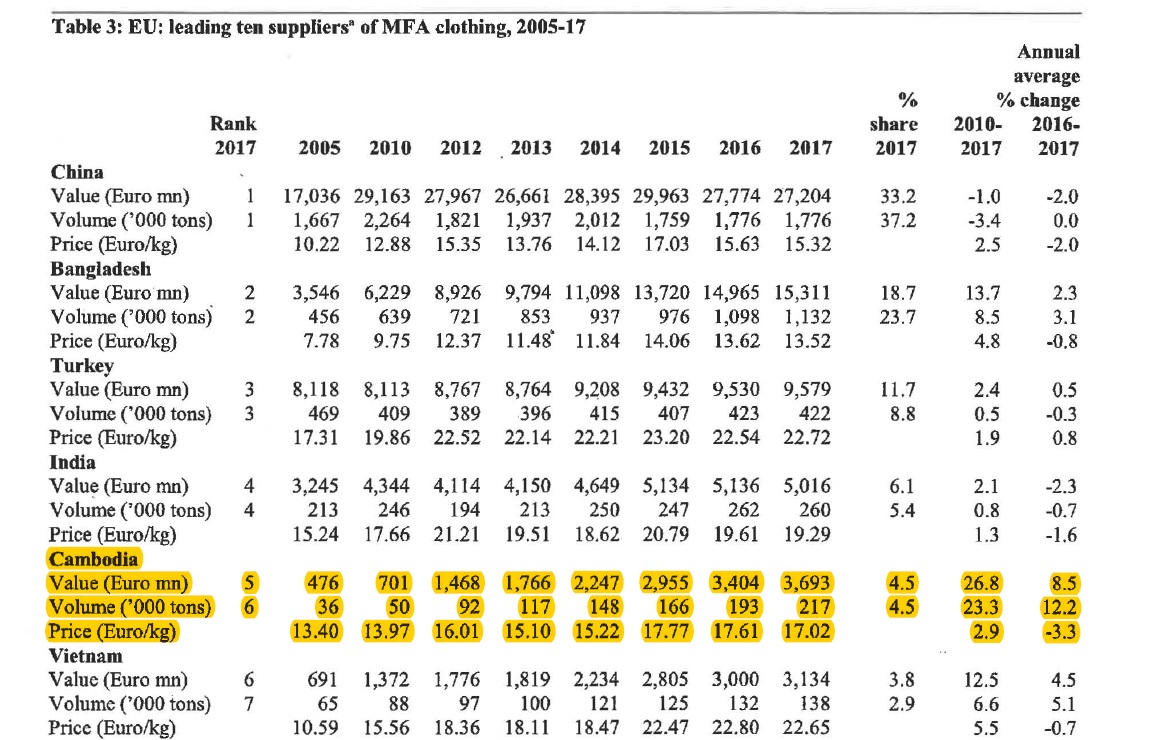
  • Many Western fashion companies are in the status of “wait and see what is going to happen.” Some delays in the arrival of their orders seem unavoidable. However, shifting sourcing orders to other countries does not seem to be a quick solution at this point either for three reasons: 1) China remains the single largest textile and apparel supplier with no alternatives (see the table above); 2) other apparel exporting countries (especially those in Asia) rely heavily on textile raw material, such as yarns and fabrics made in China. 3) for apparel factories in Asia and Africa, it is not rare to see their management team is from China. However, starting from the end of January, countries around the world have begun to impose travel restrictions targeting Chinese travelers.
  • While last year’s tariff war had already pushed Western fashion brands to source less from China, the coronavirus could accelerate companies’ sourcing diversification strategy further. Western fashion brands and retailers may also see their overall sourcing cost to go up as it requires additional resources to move products around and build new supply chains.

Outlook 2020– Key Issues to Shape Apparel Sourcing

2020

In January 2020, Just-Style consulted a panel of industry leaders and scholars in its Outlook 2020–Key Issues to Shape Apparel Sourcing Management Briefing. Below is my contribution to the report. All comments and suggestions are more than welcome!

What do you see as the biggest challenges – and opportunities – facing the apparel industry in 2020, and why?

In my view, uncertainty will remain the single biggest challenge facing the apparel industry in 2020. The rising trade barriers and geopolitical tensions, from the evolving U.S.-China trade tensions, social instability in Hong Kong, to the Brexit and U.S. election-year trade politics, could make it particularly difficult for companies to plan their businesses in both the short run and long term. As an alarming sign, the World Trade Organization (WTO) recently reported a 37% increase in restrictive trade measures taken by G20 members in 2019 compared with a year ago.

Amid the rising protectionism, the economic outlook in 2020 is also a mixed picture, at best. The latest forecasts by the World Bank and International Monetary Fund (IMF) show that, while developing economies as a whole are likely to drive much of the growth, leading apparel consumption markets in the world, including the United States, China, Japan and members of the European Union, could ALL experience slower GDP growth in 2020 than in 2019. This casts a shadow on companies’ plans for new investment and their pace of global expansion.

Meanwhile, at the micro-firm level, several issues will present as both challenges and opportunities for apparel companies in 2020. For example, moving sustainability to the next level, from product design, selection of raw material, sourcing practices to collecting and recycling used clothing, will require substantial financial investments and other resources from companies. However, as one of my recent studies indicate that sustainable apparel market has experienced particularly rapid global growth in the past few years worldwide, meaning it could be a promising growth area for apparel companies too. Likewise, more and more apparel companies are using big data and business analytics tools to gain new insights into consumers’ purchasing behaviors, competitors’ pricing practices, and even forecasting next season’s fashion trends. (As a scholar, I can also recall my studies in recent years increasingly leverage inputs from big data and business analytics tools). That being said, companies that cannot afford an in-house team of data scientists or getting access to these powerful big-data tools, unfortunately, will be at a significant disadvantage in the market competition. To a degree, the apparel business is becoming more resources-intensive in the 21st century with an ever-higher market-entry barrier.

What’s happening with sourcing? How is the sourcing landscape likely to shift in 2020, and what can apparel firms and their suppliers do to stay ahead and remain competitive into the future?

The big-landscape of apparel sourcing in 2020, interesting enough, seems to be quite similar to the “quota era” 30 years ago. Even though physical quota is no longer in place, how much products apparel companies can source from a particular country is still largely capped—except this time the quantitative restriction is imposed by a more complicated sourcing matrix, which includes factors ranging from souring cost, speed to market, production capacity, flexibility to compliance risk.

Like it or not, apparel sourcing in 2020 could become even more diversified and fragmented because of two interconnected consensuses among companies.

First, it is no longer a secret that Western fashion brands and retailers are reducing their exposure to sourcing from China, given the current business environment. For example, according to the 2019 U.S. Fashion Industry Benchmarking Study released by the U.S. Fashion Industry Association in July, a new record high of 83 percent of respondents expect to decrease sourcing from China over the next two years. Meanwhile, for the first time since 2014, China is found no longer always the top supplier for U.S. fashion companies. In fact, around 25 percent of respondents indicate that they source MORE from Vietnam than from China in 2019, an emerging trend that could continue in the years ahead.

Second, no single country has emerged to become the “next China” for apparel sourcing. I have been examining the patterns of world clothing trade and specific apparel sourcing trends in key markets such as the US, Japan, and the UK. One common finding is that China’s lost market shares have to be fulfilled by a group of countries altogether, primarily because of capacity issues. Even though it remains a question mark how much and how quickly sourcing from China will continue to drop in the next five years, it is for sure that the population in Vietnam, Bangladesh, and other countries deemed as China’s alternatives will NOT double. This explains why many fashion brands and retailers both in the US and EU say they will continue to maintain a “relatively diverse” sourcing base, and in the context of the apparel industry, it actually means sourcing from more than 20 or even 50 different countries or regions.

Third, while companies are sourcing from more countries, many of them are working with fewer vendors. The primary considerations include reducing cost, driving compliance, improving operational efficiency and strengthening the relationship with strategic supply chain partners.

Additionally, we may pay attention to the reaching or implementation of several free trade agreements (FTAs) in 2020 that involve important apparel importing and exporting countries. Notably, FTAs not only offer preferential duty treatment but also play a critical role in shaping new supply chains and maintaining existing ones. For example:

  • The potential reaching of the Regional Comprehensive and Economic Partnership (RCEP) may strengthen further the regional textile and apparel production and trade network among Asian countries. The agreement could also accelerate China’s transition from being an apparel exporter to a critical textile supplier for many Asian-based apparel-exporting countries.
  • Hopefully, the EU-Vietnam Free Trade Agreement (EVFTA) will be implemented in 2020. However, EU and US apparel companies may have to compete more intensely for sourcing orders from Vietnam then, resulting in higher sourcing costs and potentially greater risks in social compliance.
  • The U.S.-Mexico-Canada Free Trade Agreement (USMCA) is on the track to be ratified by all parties and go into force in early 2020, but with no 100% guarantee. However, the newly added 16-year “sunset clause” and the “6th-year” review mechanism could open new debates and controversies on the agreement. Further, as the new agreement includes higher labor and environmental standards and stronger enforcement mechanisms for these rules, how will these provisions affect the apparel industry, from production cost to compliance risk, is worth watching.
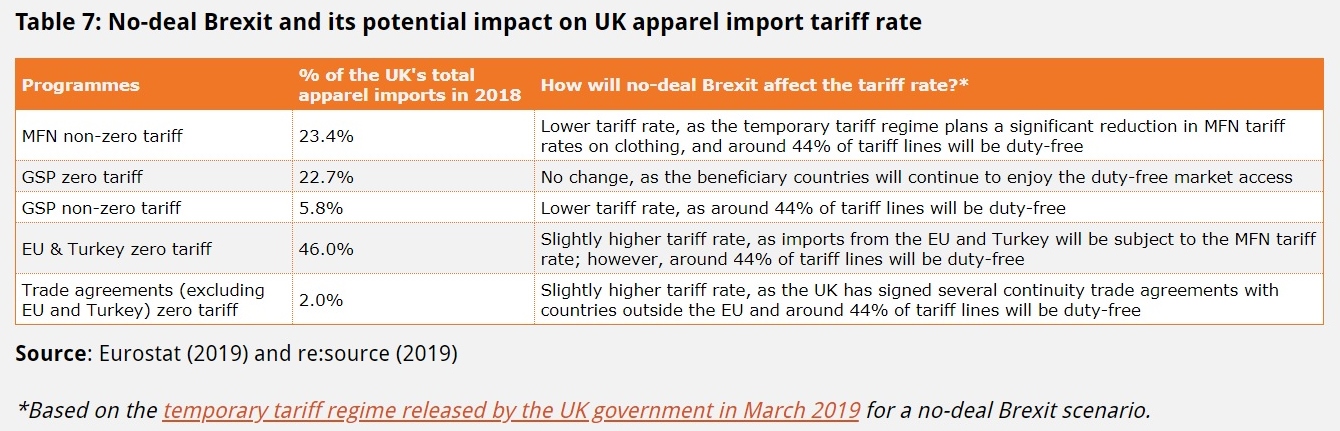
  • Under which terms the UK will leave the European Union (i.e., Brexit) could also result in a shift in apparel sourcing. In the no-deal Brexit scenario, in particular, the temporary tariff regime is likely to result in overall lower tariff rates for products sourced from countries like China that currently do not have a free trade agreement with the EU. However, UK companies could face a higher tariff when they source products from the EU, Turkey or countries that currently have a free trade agreement with the EU. As always, there will be both winners and losers in a delicate way.

Interview with Modaes.es on the Latest Trends of Apparel Sourcing and Trade

The original interview (in Spanish) is available HERE. Below is the translated version.

Question: Is there a reversal in the globalization of fashion?

Sheng Lu: The fashion industry is becoming more global AND regional — the making and selling of a garment “travel” through more and more countries. Just look at the label of a Gap sweatshirt: it is an American clothing brand, but the product is “Made in Vietnam,” and the label includes the size standards in six different countries. The business model of the fashion industry today is “making anywhere in the world and selling anywhere in the world.”

Q .: What do you mean the industry is becoming more “regional”?

Sheng Lu: The trade flows of textiles and apparel today are heavily influenced by regional free trade agreements (FTAs). For example, while China is known as the world’s largest apparel producer and exporter, nearly 50% of the clothing consumed by European consumers are still produced by EU countries themselves. Notably, consumers have different expectations for clothing: many are price-sensitive, but others prefer more trendy items, which requires “near sourcing”—this explains why fashion companies have to adopt a more balanced sourcing portfolio.

Q .: Is the price still the most important factor in fashion companies’ sourcing decisions?

Sheng Lu: Sourcing is far more than just about chasing for the lowest cost. Sourcing decisions today have to consider a mix of factors, ranging from flexibility, speed to market, sustainability, to compliance risks. In fact, few companies “put all eggs in one basket.” My recent studies show that both in the United States and the EU, fashion companies with more than 1,000 employees, typically sourced from more than twenty different countries—sometimes even exceed forty. Behind such a diversified sourcing practice is the necessity to strike a balance between so many different sourcing factors.

Q .: Is apparel sourcing becoming more diversified today than a decade ago?

Sheng Lu: From my observations, fashion companies are souring from more countries and regions than a decade ago, but not in terms of producers. Especially in the last two or three years, I see some large companies are consolidating their supplier base to build a closer relationship with key vendors. The reason is the same as mentioned earlier: a very competitive price is not enough for apparel sourcing today.

Q .: How has the tariff war between the United States and China affected apparel sourcing?

Sheng Lu: The trade war between the United States and China is having big impacts on apparel sourcing that go beyond the two countries. Notably, American fashion brands and retailers are moving sourcing orders from China to other Asian countries such as Vietnam and Bangladesh. However, finding China’s alternatives is anything but easy. Despite the tariff war, China remains a competitive player in apparel sourcing. The unparalleled production capacity that can fulfill orders nearly for any products in any quantity, and the ability to comply with complex sustainability and social responsibility regulations are among China’s unique competitive advantages. Understandably, companies are not giving up sourcing from China, as there are few other “balanced” sourcing destinations in the world. That being said, it is important to recognize that the big landscape of apparel sourcing is evolving. Even in Europe, which is not having a trade war with China, apparel “Made in China” is seeing a notable decline in its market share.

Q .: How is China adapting?

Sheng Lu: The textile and apparel industry in China is undergoing a structural change. Partially caused by the tariff war, apparel producers in China are increasingly moving their factories to nearby Asian countries (especially for big-volume and/or relatively low value-added product categories). Meanwhile, China itself is changing from an apparel producer to become a leading textile supplier for other apparel-exporting countries in Asia. This is NOT a temporary move, but a permanent transition, which has happened in many industrialized economies in history. Somehow, the tariff war has accelerated the adjustment process, however.

Q .: Will Africa be the next hub for apparel sourcing in the near future?

Sheng Lu: As textile and clothing trade is turning more regional-based, Africa is facing significant challenges to become an attractive tier-1 sourcing base for Western fashion brands and apparel retailers.

Q .: Why is that?

Sheng Lu: In general, there are three primary apparel import markets in the world: the United States, the European Union, and Japan—as of 2018, these three regions altogether still accounted for as many as 70% of the world apparel imports. Surely, Asian countries are important apparel suppliers for all these three regions. However, each of these three markets also has its respective regional suppliers—Mexico and Central & South American countries for the United States, China, and a few Southeast Asian countries for Japan and Eastern European countries for the EU market. Other than geographic proximity, often, these regional suppliers also enjoy preferential market access to the US, EU, and Japan provided by regional free trade agreements.

Africa, on the other hand, is not close to any of these three major apparel import markets geographically. Why would fashion companies in the United States, Japan, or the EU have to source from Africa when there are so many other options available?

Q .: For price?

Sheng Lu: Several trade preference programs currently offer apparel exporters in African countries preferential or duty-free market access to the United States, the EU, and Japan (such as the African Growth Opportunity Act and the EU and Japan Generalized System of Preferences programs). However, sourcing from Africa will entail other extra costs—for example, the raw material cost will be higher as yarns and fabrics have to be imported from Asia first, and the transportation bill could be costly due to the poor infrastructure. Further, not like their counterpart in Asia, the apparel industry is not regarded as a development priority in many African countries, which continue to rely heavily on the export of raw materials instead. Manufacturing for the local market is also complicated—apparel producers in Africa are struggling with both the cheap clothing imported from Asia and the mounting used clothing sent from the West.

Q .: It is said that fashion might be the most regulated sector in international trade other than agriculture. How to explain this?

Sheng Lu:  I think we need some changes here. For example, in 2018, textiles and apparel accounted for only 5% of the total U.S. merchandise imports but contributed nearly 40% of the tariff revenue collected. This phenomenon, which makes no sense economically, is the result of the industry lobby—trying to protect domestic manufacturers from import competition.

As another example, around 15%-17% of Mexico’s clothing exports to the United States do not claim the duty-free benefits provided by the North American Free Trade Agreement (NAFTA), as the NAFTA rules of origin strictly require the using of regional yarns and fabrics for qualified apparel items. In the end, companies prefer bigger savings on the raw material cost than claiming the NAFTA duty-saving benefits. We should think about how to modernize these trade rules and make them more supply-chain friendly in the 21st century.

Meanwhile, policymakers are developing new regulations to address some emerging areas in international trade, such as E-commerce, labor standards and environmental protection. Increasingly, trade policy is moving from “measures at the border” to “measures behind the borders.”

Top Ten Most-read Blog Posts on Shenglufashion in 2019

download.png

#1 WTO reports world textile and apparel trade in 2018

#2 Wage level for garment workers in the world (updated in 2017)

#3 China’s changing role in the world textile and apparel supply chain

#4 Timeline of trade policy in the Trump administration

#5 State of the EU textile and apparel industry (updated April 2019)

#6  2019 U.S. fashion industry benchmarking study released

#7 U.S. textile and apparel industry is NOT immune to the U.S.-China tariff war

#8 U.S. apparel retailers’ shifting sourcing strategy for “Made in China” under the shadow of the tariff war

#9 Demystify the “Made in the USA” apparel sourcing strategy

#10 U.S. textile and apparel industry assesses the impacts of USMCA (NAFTA2.0)

Happy Holidays!

New Analysis: UK’s Apparel Sourcing Patterns under the Shadow of Brexit

UK1.jpg

The full article is available HERE

Key findings:

First, mirroring the trend of aggregate market demand, the value of UK’s apparel imports has only grown marginally over the past decade. Specifically, between 2010 and 2018, the compound annual growth rate of UK’s apparel imports was close to zero, which was notably lower than 1.4% of the world average, the United States (1.9%), Japan (1.5%) and even the European Union as a whole (1.1%).

Second, UK’s fashion brands and retailers are gradually reducing imports from China and diversifying their sourcing base. Similar to other leading apparel import markets in the world, China was the largest apparel-sourcing destination for UK fashion companies, followed by Bangladesh, which enjoys duty-free access to the UK under EU’s Everything But Arms (EBA) program. Because of geographic proximity and the duty-free benefits under the Customs Union with the EU, Turkey was the third-largest apparel supplier to the UK.

Affected by a mix of factors ranging from the increasing cost pressures, intensified competition to serve the needs of speed-to-market better, the market shares of “Made in China” in the UK apparel import market had dropped significantly from its peak of 37.2% in 2010 to a record low of 21.4% in 2018. However, no single country has emerged to become the “next China” in the UK market. Notably, while China’s market shares decreased by 6.3 percentage points between 2015 and 2018, the next top 4 suppliers altogether were only able to gain 0.7 percentage points of additional market shares over the same period.

Third, despite Brexit, the trade and business ties between the UK and the rest of the EU for textile and apparel products are strengthening. Thanks to the regional supply chain, EU countries as a whole remain a critical source of apparel imports for UK fashion brands and apparel retailers. More than 33% of the UK’s apparel imports came from the EU region in 2018, a record high since 2010. On the other hand, the EU region also is the single largest export market for UK fashion companies.

UK2

Fourth, the potential impacts of no-deal Brexit on UK fashion companies’ sourcing cost seem to be modest:

  • For products currently sourced from countries without a free trade agreement with the EU (such as China) and those Generalized System of Preferences (GSP) beneficiaries that enjoy non-zero preferential duty rates, the tariff rate in the no-deal Brexit scenario will be lower than the current level, as round 44% of tariff lines will be duty-free.
  • For products currently sourced from countries that enjoy duty-free benefits under the GSP program (such as EBA beneficiary countries), their duty-free market access to the UK will remain unchanged according to the temporary tariff regime.
  • Products currently sourced from EU countries and Turkey will lose the duty-free benefits and be subject to the MFN tariff rate. However, because around 44% of tariff lines will be duty-free, the magnitude of tariff increase should be modest.
  • Likewise, products currently sourced from countries that enjoy duty-free benefits under an EU free trade agreement could lose the duty-free treatment and be subject to the MFN tariff rate. However, as around 44% of tariff lines will be duty-free and the UK has signed several continuity trade agreements with some of these countries, the magnitude of tariff increase should be modest overall too. Additionally, these countries are minor sourcing bases for UK fashion companies.

 About the authors: Victoria Langro is an Honors student at the University of Delaware; and Dr. Sheng Lu is an Associate Professor in Fashion and Apparel Studies at the University of Delaware.

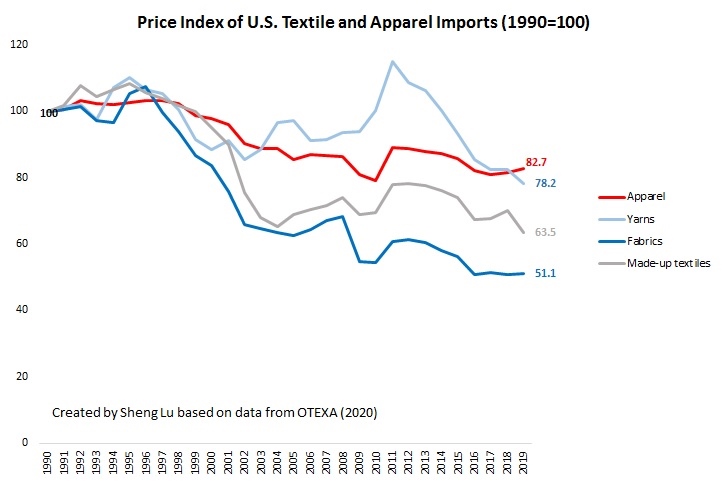
How Has the Tariff War Affected the Competitiveness of China’s Textile and Apparel Exports to the U.S.? (December 2019)

yarns.jpg

fabric.jpg

apparel.jpg

made up textiles.jpg

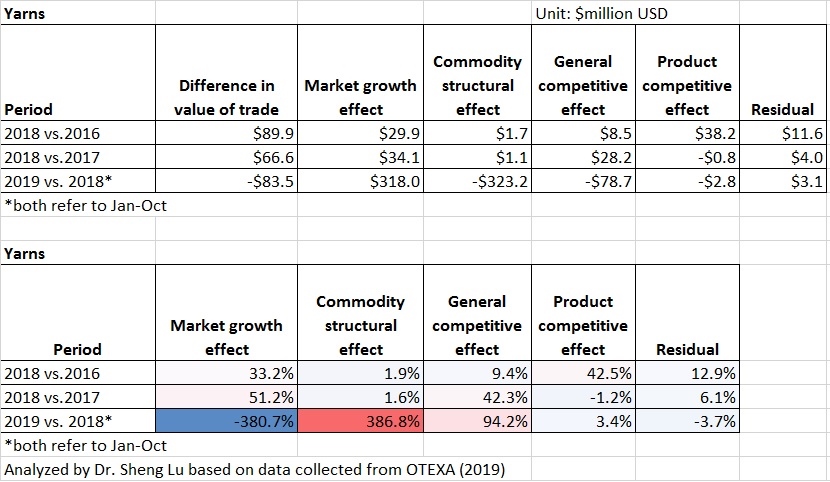
This study intends to explore how has the U.S.-China trade tension since 2017 affected the competitiveness of China’s textile and apparel (T&A) exports to the U.S. market. The findings of the study will shed new light on the mega-trend of T&A sourcing from China in the medium term, and support T&A companies’ sourcing decision making in the current uncertain business environment.

Data for the analysis were collected from the Office of Textiles and Apparel (OTEXA) under the U.S. Department of Commerce, including the value of U.S. imports from China between 2016 (i.e., the year before the U.S. launched the section 301 investigation against China) and October 2019 (the latest data available) for a total of 167 categories of T&A products.

Specifically, based on the constant market share (CMS) model, a commonly adopted international trade analysis tool, this study decomposed the value of U.S. T&A imports from China into the following four factors:

  • Market growth effect: changes in China’s T&A exports to the U.S. due to the growth of total U.S. import demand for T&A
  • Commodity structural effect: changes in China’s T&A exports to the U.S. due to the shifting product structure of China’s T&A exports
  • General competitive effect: changes in China’s T&A exports to the U.S. due to the shifting competitiveness of Chinese T&A products in the U.S. market (measured by China’s market shares)
  • Product competitive effect: changes in China’s T&A exports to the U.S. due to the joint effect of the product structure of China’s T&A exports and the shifting competitiveness of Chinese T&A products in the U.S. market (measured by China’s market shares)

Four findings are of note:

First, the U.S.-China trade tension has affected China’s T&A exports to the U.S. negatively. Even though Section 301 tariffs on the majority of apparel products didn’t start until September 2019, China’s T&A exports to the U.S. had suffered a significant drop. This result, however, was at odds with the overall trend of China’s T&A exports to the U.S. in recent years. Notably, except apparel, China’s yarns, fabrics and made-up textile exports to the U.S. all enjoyed a steady and positive growth between 2016 and 2018. The impact of the tariff war is real.

Second, the increased U.S. import demand has partially mitigated the negative impact of trade tension on China’s T&A exports to the U.S. market. Results of the CMS model indicate that expanded total U.S. import demand for T&A driven by the booming U.S. economy had avoided an even worse decline of U.S. T&A imports from China. In other words, without such a market growth, China’s T&A exports to the U.S. would have been $2,065 million less in 2018 (including $528 million for apparel) and $878 million less (including $613 million for apparel) in the first ten months of 2019 than their current level.

Third, China’s export competitiveness is shifting from apparel to textiles. Results of the CMS model show that even before the tariff war, the competitiveness of China’s apparel exports has been weakening steadily, which was the most significant contributing factor to the decline of $530 million U.S. apparel imports from China between 2016 and 2018. In comparison, China is exporting more yarns and fabrics to the U.S. in recent years. Data from OTEXA shows that between 2016 and 2018, China’s yarn and fabric exports to the U.S. enjoyed a 13.1% and 2.6% compound annual growth, respectively, compared with a 0.6% decline of apparel. The CMS model further suggests that China’s improved export competitiveness can explain the majority of these increased exports.

Fourth, China is adjusting its T&A export structure to mitigate the negative impact of the tariff war. As estimated, through targeting those product categories with higher growth in import demand, China was able to achieve an additional $36.7 million apparel export to the U.S. in the first ten months of 2019.  Likewise, the commodity structural effect also favored China’s made-up textile exports to the U.S. market in 2019, resulting in $148.7 million more exports than otherwise.

By Sheng Lu

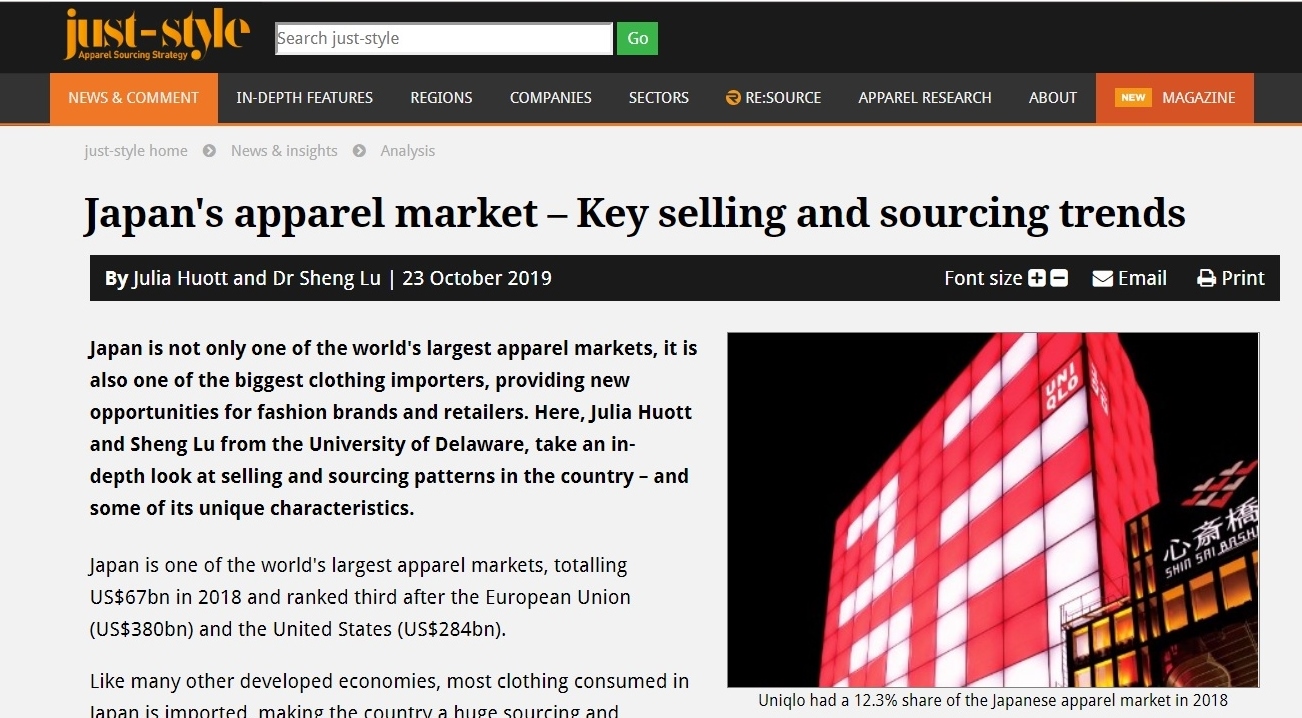
Japan’s Apparel Sourcing Patterns

Untitled.jpg

(The full article is available HERE)

Key findings:

First, the total value of Japan’s apparel imports has been growing steadily in line with consumption patterns. Between 2010 and 2018, the value of Japan’s apparel imports enjoyed a 2.7% compound annual growth rate, which was lower than the US (3.4%), but higher than the EU (1.9%) and the world average (1.3%) over the same period.

Second, while China remains the top supplier, Japanese fashion brands and retailers are also diversifying their sourcing bases. Similar to their counterparts in the US and EU, Japanese fashion brands and retailers are actively seeking alternatives. Imports from Vietnam, Bangladesh, and Indonesia have been growing particularly fast, even though their production capacity and market shares are still far behind China.

helmut-lang-cream-silk-v-neck-asymmetrical-sweaterpullover-size-0-xs-4-0-960-960.jpg

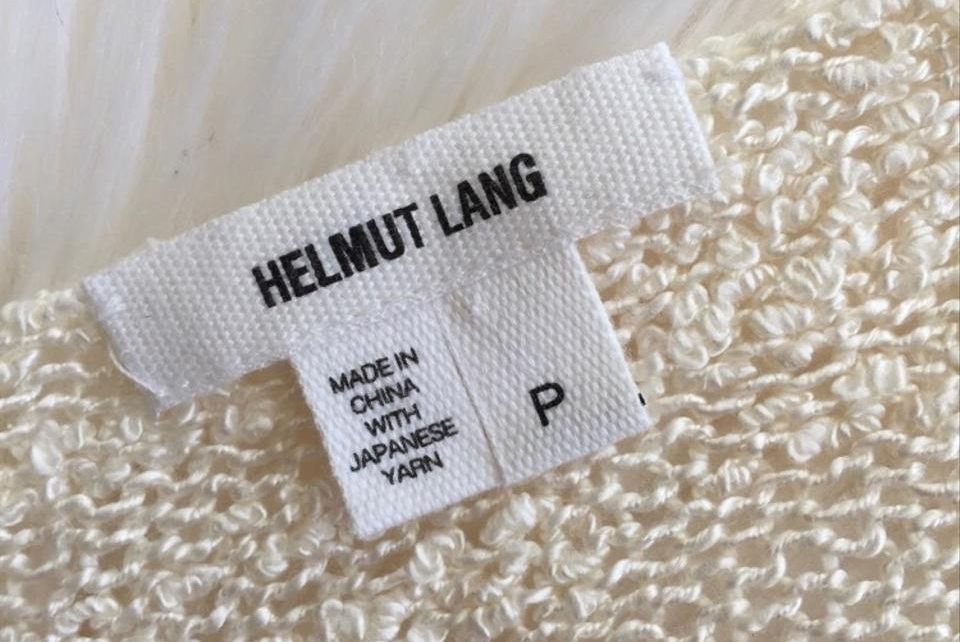
Third, Japanese fashion companies are increasingly sourcing from Asia. As of 2018, only 7.5% of Japan’s apparel imports came from non-Asian countries (mostly western EU countries), a notable drop from 11.4% back in 2000. A good proportion of Japan’s apparel imports from Asia actually contain fibers and yarns originally made in Japan. For example, it is not difficult to find clothing labeled ‘Made in China’ or ‘Made in Vietnam’ that also includes phrases such as ‘Using soft, slow-spun Japanese fabric’ and ‘With Japanese yarns’ in the detailed product description.

Fourth, overall, Japan sets a lower tariff barrier for apparel than other leading import countries. As of September 2019, there were around 15 FTAs and TPAs in force in Japan, whose members include several 1st tier apparel supplying countries in Asia, such as Vietnam, Bangladesh, India, Indonesia, and Cambodia. Most of these trade programs adopt the so-called “fabric-forward” rules of origin (also known as “double-transformation” rules of origin). Additionally, Japan is actively engaged in negotiations on a trilateral free trade agreement with China and South Korea, and the Regional Comprehensive Economic Partnership (RCEP), which involves Japan, South Korea, China and members of the Association of Southeast Asian (ASEAN) countries. Once reached and implemented, these trade agreements will provide new exciting duty-saving sourcing opportunities, including from China, the top apparel exporter in the world.

The Changing Face of Textile and Apparel “Made in Asia”

Video 1: How one Chinese shirt-maker uses automation to safeguard its future

Video 2: Chinese investors move clothing factory to Bangladesh

Video 3: Can Vietnam become the next China?

Discussion questions (for FASH455: Please finish watching ALL the three short videos above before sharing your viewpoints)

  1. How are textile and apparel “Made in Asia” changing its face? What are the driving forces of these changes?
  2. What are the examples of the “flying geese model” from the videos? Overall, why or why not do you think this model is still valid today?
  3. Why or why not do you think the U.S.-China tariff war has fundamentally changed the patterns of textile and apparel production and trade in Asia?

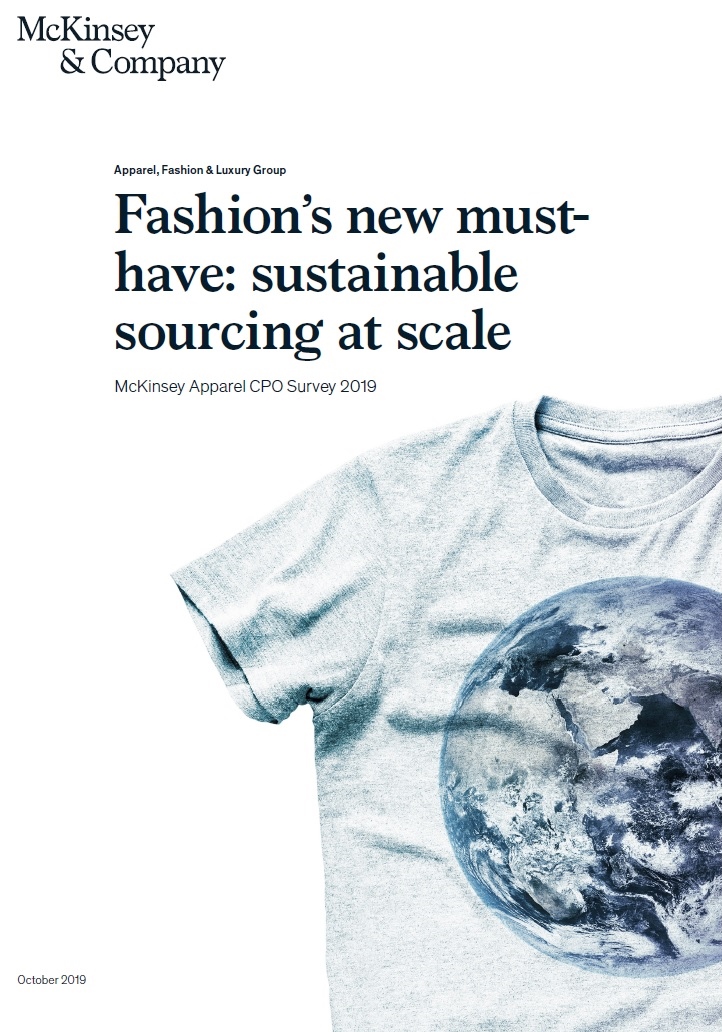
New Report: Fashion’s New Must-have—Sustainable Sourcing at Scale

Untitled

The study was based on a survey of 64 sourcing executives from vertical apparel retailers, hybrid wholesalers, and sportswear companies, with a total sourcing volume of $100 billion. Below are the key findings of the report:

  • More sourcing executives now focus on process improvements in their companies, such as sustainability and transparency (56% of respondents), digitalization of sourcing process and related areas (45% of respondents), consolidation of supplier base (42% of respondents), end-to-end process efficiency (41% of respondents) than shifting sourcing countries (20% of respondents). Related, as cost gaps between sourcing destinations are narrowing, apparel companies are shifting from minimizing the price of supply to a focus on customer-centric, agile product development to meet customer demand. Digitalization, such as intelligent sourcing, is one of the most promising areas.
  • Affected by the on-going U.S.-China tariff war, two-thirds of surveyed companies expect their overall sourcing cost to increase in the years ahead, including 37.5% expecting a 2-4% increase and 25% expecting 1-2% increase. However, only 3.1% of respondents expect a significant cost increase (>4%).
  • Echoing the findings of other recent studies, respondents plan to source relatively less from China through 2025. Bangladesh, Vietnam, Myanmar, and Ethiopia are among the top alternative sourcing destinations. Meanwhile, more companies are considering near-sourcing. The biggest challenge, however, is limited fabric production capacity, NOT higher wages.
  • Sustainable apparel sourcing is regarded as a must—70% of EU companies and 35% of North American companies surveyed say “responsible and sustainable sourcing was on the CEO agenda.” Top challenges to achieve sustainable apparel sourcing include “no common, objective industry standard on sustainable sourcing”, “consumers lack a clear picture of what sustainable fashion is all about”, “mixed influence of the sourcing function in company-wide sustainability strategy.” Further, more companies prioritize environmental-sustainability initiatives (issues such as sustainable material, recycled material, traceability, and packing) than social sustainability initiatives (issues such as) fair on living wage and decent work). Additionally, respondents hold competing views on whether sustainability will increase sourcing costs overall. Around 58% of respondents see additional costs for sustainable sourcing between 1% and 5%.
  • Sustainability will play an increasingly important role in how apparel companies select their suppliers. Some surveyed apparel brands and retailers say they have upgraded their supplier ratings over the last couple of years, moving away from viewing sustainability simply as a compliance-based hygiene factor and instead embracing criteria that are more sophisticated.
  • There is also a need to shift from the transactional-based, season-by-season and the low-commitment relationship between apparel companies and their vendors to strategic partnerships between the two. Around 73% of respondents plan to consolidate their supplier base by at least 5% over the next few years. Related, apparel companies increasingly empower suppliers for self-auditing with tools like the Higg Index.

U.S.-Japan Trade Agreement (Updated: September 2019)

US_Japan_flags

On 16 September 2019, the Trump administration notified U.S. Congress of its intent to enter into a trade agreement on “tariff barriers” with Japan as well as an “executive agreement” on digital trade. According to the announcement, the Trump administration plans to utilize Section 103(a) of the 2015 Trade Promotion Authority law, which allows the president to modify tariffs WITHOUT congressional approval. While details of the tariff agreement are not yet available, U.S. Trade Representative Robert Lighthizer in August said the deal with Japan would focus on beef, pork, wheat, dairy products, wine, and ethanol, as well as on industrial goods.

The 16 September notification also says the Trump administration will “further negotiations with Japan to achieve a comprehensive trade agreement that results in more fair and reciprocal trade between the United States and Japan.” Such a more comprehensive trade agreement, however, will require congressional approval.

On December 21, 2018, Office of the U.S. Trade Representative (USTR) released negotiating objectives of the proposed U.S.-Japan Free Trade Agreement (USJTA). Overall, USJTA aims to address both tariff and non-tariff barriers to achieve fairer and more balanced trade between the two countries. Regarding the textiles and apparel sector, USTR says it will “secure duty-free access for U.S. textile and apparel products and seek to improve competitive opportunities for exports of U.S. textile and apparel products while taking into account U.S. import sensitivities” during the negotiation. USJTA also will “establish origin procedures for the certification and verification of rules of origin that promote strong enforcement, including with respect to textiles.”

Should the newly announced U.S.-Japan trade deal remove the tariffs for textiles and apparel traded between the two countries, the overall economic impact on related trade flows could be modest. Data from the UNComtrade shows that in 2018 U.S. imported $656 million textiles (SITC 26 and 65) and $88 million apparel (SITC 84) from Japan, accounting for 2.1% and 0.1% of total U.S. textile and apparel imports respectively. Meanwhile, in 2018 Japan imported around $353 million textiles and $121 million apparel from the U.S., accounting for 3.7% and 0.4% of Japan’s total textile and apparel imports that year respectively.

In comparison, over 70% of U.S. textile and apparel exports went to the Western-Hemisphere and U.S. imported textiles and apparel mostly from NAFTA & CAFTA-DR members and other Asian countries (such as China and Vietnam). Likewise, Japan also has a much closer trade tie with other Asian countries because of the regional textile and apparel trade patterns (or commonly known as “factory Asia”).

japanUS

On the other hand, the elimination of tariffs and potentially non-tariff barriers under the U.S.-Japan trade deal could expand the bilateral trade flows for technical textiles. Notably, the top categories of U.S. textile and apparel exports to Japan in 2018 were mostly technical textiles such as specialty and industrial fabrics, filament yarns, and non-woven textiles. Likewise, the top categories of Japan’s textile and apparel exports to the U.S. in 2018 also include special-purpose fabric, non-woven fabric, and synthetic filament fabrics.

Additionally, the textiles and apparel-specific rules of origin (RoO) is likely to remain a heated debate in the US-Japan trade negotiation. To protect the interests of the U.S. textile industry and the Western-Hemisphere regional textile and apparel supply chain, most free trade agreements enacted in the United States adopt the so-called “yarn-forward” RoO. Even though the U.S.-Japan trade agreement may not be a too big deal economically, the U.S. textile industry is unlikely to give up the RoO fight. However, most free trade agreements enacted in Japan adopt more liberal fabric-forward rules of origin (or commonly called “double transformation”). As textile and apparel production in Japan is increasingly integrated with other Asian countries, the strict “yarn-forward” RoO could prevent Japanese textile and apparel exporters from enjoying the preferential duty benefits under the U.S.-Japan trade agreement fully.

Brexit and the Global Fashion Industry: Discussion Questions from FASH455

skynews-brexit-westminster_4764028

#1 To which extent should globalization be responsible for Brexit? Does Brexit imply globalization is in retreat? Why or why not?

#2 Why do you think the fashion industry is a stakeholder of “Brexit”? It is said that “some of the world’s poorest countries may end up the victims of Brexit.” Why is that?

#3 The article mentioned the possibility of London losing its reputation as a global fashion capital because of Brexit. What is your evaluation?

#4 Should the UK fashion industry vote for Brexit? Why or why not?

#5 Overall, from the case of Brexit, how do you understand that textile and apparel is a global sector?

[For FASH455: 1) Please mention the question number in your comments; 2) Please address at least TWO questions in your comments]

[Discussion for this post is closed]

15% and 25% Section 301 Punitive Tariffs on Apparel Imports from China: Retail Price Impact Assessment

1

2.jpg

3.jpg

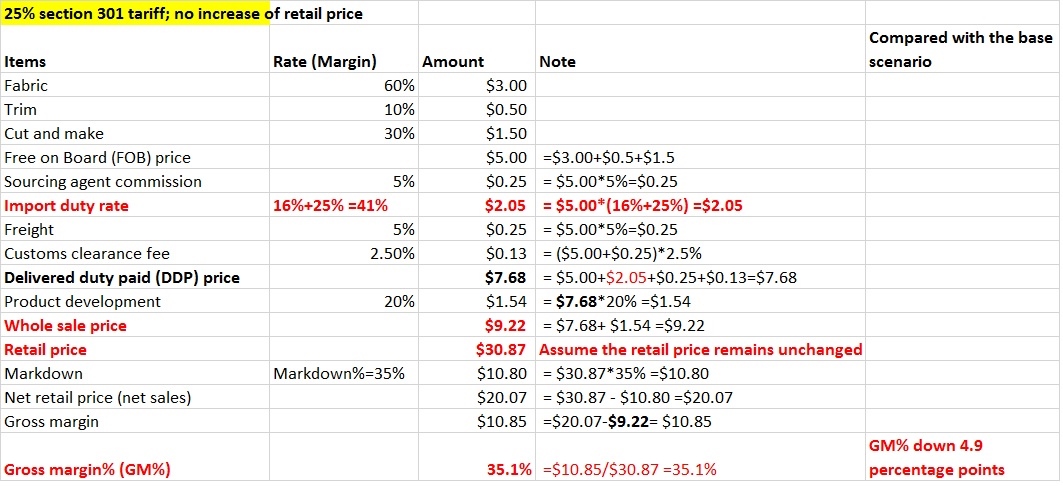
The Trump administration has imposed 15% Section 301 punitive tariffs on $300 billion Chinese products (tranche 4) effective September 1, 2019, which includes almost 80% of U.S. apparel imports from China. As illustrated above, 15% punitive tariffs mean:

  • If the retailer keeps the retail price unchanged, its gross margin% could drop around 2.9-3 percentage points.
  • If the retailer tries to maintain a gross margin% of 40%, it may have to increase the retail price by around 11.5-12%.

3.jpg

4.jpg

Likewise, should the punitive tariffs reach 25%, it means:

  • If the retailer keeps the retail price unchanged, its gross margin% could drop around 4.9-5.0 percentage points.
  • If the retailer tries to maintain a gross margin% of 40%, it may have to increase the retail price by around 19.4-20%.

(Welcome for any comments and suggestions)

by Sheng Lu

American Giant: $108 Hoodie Made in the USA

Untitled

Discussion questions:

  1. Is it still meaningful to promote apparel 100% “Made in the USA” in today’s global economy? Why or why not?
  2. From the video, what is your evaluation of the strength, weakness, opportunity, and threat of American Giant’s business?
  3. From the video and our class discussions, why or why not do you think the U.S.-China tariff war has benefited textiles and apparel “Made in the USA”?
  4. Will you be interested in working in a textile mill/garment factory as featured in the video after graduation? Why or why not?
  5. Any other thoughts/reflections from the video?

[For FASH455: 1) Please mention the question number in your comments; 2) Please address at least TWO questions in your comments]

Additional readings:

U.S.-China Tariff War Escalates–Impact on Apparel and Footwear

Background: In response to China’s decision to impose 5%–10% retaliatory tariffs on $75 billion U.S. products, on August 23, 2019, the Trump administration announced to raise the Section 301 tariffs from 25% to 30% for around $250 billion Chinese products (tranche 1, 2 and 3), effective October 1, 2019. The scheduled Section 301 tariffs on $300 billion Chinese products (tranche 4) to take into effect on September 1, 2019 and December 15, 2019 will also be increased from 10% to 15%.

IMG_0998
Trump lashes out at China, sending markets reeling

U.S. fashion brands and retailers are deeply concerned about the negative impacts of the tariff war on their businesses. According to the 2019 U.S. Fashion Industry Benchmarking Study released by the U.S. Fashion Industry Association, even without considering the upcoming 10-15% tariffs to be imposed on around $35.7 billion Chinese textiles and apparel covered by tranche 4:

  • The trade diversion effect of Section 301 has accelerated U.S. fashion companies’ pace of reducing sourcing from China. About 83 percent of respondents expect to decrease sourcing from China over the next two years, up further from 67 percent in 2018.
  • The Section 301 action is pushing up the price of U.S. apparel imports across the board, making “increasing production and sourcing cost” the top business challenge for respondents in 2019. As much as 63 percent of respondents explicitly say the U.S. Section 301 tariff action against China “increased my companies’ sourcing cost” in 2019. As companies are moving sourcing orders to Bangladesh, Vietnam, and India, the average price of U.S. apparel imports from these countries – the main alternatives to China — have all gone up very quickly.
  • No evidence shows that Section 301 has benefited near-sourcing from the Western Hemisphere and reshoring from the United States significantly. Instead, respondents say Section 301 has increased the production costs of textiles and apparel “Made in the USA.”
  • Respondents say they are reluctant but may have to increase their retail prices, should the U.S.-China tariff war escalate further.

Related reading:

When ‘Made in Vietnam’ Products Are Actually From China

As described in the video, transshipment is one form of illegal import activities and occurs when false country-of-origin information is provided for imported goods in order to evade U.S. customs duties. Transshipment was a major issue in textile and apparel trade back in days when the quota system was still in place.

According to the media, because of the escalating U.S.-China tariff war, customs fraud such as transshipment is thriving again. Some fashion companies are also using tariff engineering to avoid paying the punitive tariffs in a legal way. Indeed, how to label “Made in ___” can be much more complicated, technical and subtle than we realize.

Related reading:

WTO Reports World Textile and Apparel Trade in 2018

Updated data in 2019 is now available: WTO Reports World Textiles and Apparel Trade in 2019
1

2.jpg

According to the World Trade Statistical Review 2019 newly released by the World Trade Organization (WTO), the current dollar value of world textiles (SITC 65) and apparel (SITC 84) exports totaled $315 billion and $505 billion in 2018 respectively, increased by 6.4% and 11.1% from a year earlier. This has been the fastest growth of world textile and apparel trade since 2012. Specifically: 

I. Textile export

China, European Union (EU28), and India remained the world’s top three exporters of textiles in 2018. Altogether, these top three accounted for 66.9% of world textile exports in 2018, a new record high since 2011. Notably, China and EU (28) also enjoyed a faster-than-world-average export growth in 2018, up 7.9% and 6.9% respectively. The United States remained the world’s fourth top textile exporter in 2018, accounting for 4.4% of the shares, down slightly from 4.6% in 2017.

II. Apparel export

China, the European Union (EU28), Bangladesh, and Vietnam unshakably remained the world’s top four largest exporters in 2018. Altogether, these top four accounted for as much as 72.3% of world market shares in 2018, which, however, was lower than 75.8% in 2017 and 74.3% in 2016—primarily due to China’s declining market shares. Notably, even though apparel exports from Vietnam (up 13.4%) and Bangladesh (up 11.1%) enjoyed a fast growth in absolute terms in 2018, their gains in market shares were quite limited (up 0.3 percentage point from 5.9% to 6.2% for Vietnam and up 0.1 percentage point from 6.4% to 6.5% for Bangladesh). This result once again suggests that due to capacity limits, no single country has emerged to become the “Next China.” Instead, China’s lost market shares in apparel exports were fulfilled by a group of countries, a phenomenon which can be linked with fashion brands and retailers’ sourcing diversification strategy.

III. Textile import

The European Union (EU28), the United States, and China were the top three largest importers of textiles in 2018, accounting for 37.5% of the world’s total textile imports that year. Although the market shares of the top three in 2018 were close to 37.7% a year earlier, it nevertheless was much lower than over 50% back in the 2000s. The increasing diversification of textile import market is associated with the shifting pattern of world apparel manufacturing and export closely.

IV. Apparel import

Affected by consumers’ purchasing power (often measured by GDP per capita) and size of the population, the European Union, the United States, and Japan remained the world’s top three importers of apparel in 2018. Altogether, these top three absorbed 61.5% of world apparel in 2018, which, however, was lower than 62.3% in 2017 and a significant drop from 84% back in 2005. Behind the result, it is not the case that consumers in the EU, U.S., and Japan are importing less clothing. Instead, several emerging economies (such as China) are becoming fast-growing apparel consumption markets and starting to import more. As consumers’ purchasing power in these emerging economies continues to improve, we could expect a more diversified world apparel import market in the years ahead.

textile

clothing.jpg

Additional reading: Latest trends in world textile and apparel trade

Challenges facing Sub-Saharan Africa (SSA) as an Apparel Sourcing Base

2559302604b1a6b334ad302dec1864ce

Sub-Saharan Africa (SSA) is widely regarded as a growing apparel-souring destination. Particularly, U.S. Congress established the African Growth and Opportunity Act (AGOA), a non-reciprocal trade preference program, in 2000, to help developing SSA countries grow their economy through expanded exports to the United States. Because apparel production plays a dominant role in many SSA countries’ economic development, apparel has become one of the top exports for many SSA countries under AGOA. Notably, the “third-country fabric provision” under AGOA allows US apparel imports from certain SSA countries to be qualified for duty-free treatment even if the apparel items use yarns and fabrics produced by non-AGOA members, such as China, South Korea, and Taiwan. This special rule is deemed as critical as most SSA countries still have no capacity in producing capital and technology-intensive textile products.

That being said, to play a bigger role as an apparel sourcing base, SSA is not without significant challenges:

1

Challenge 1: limited industry upgrading and local textile production capacity

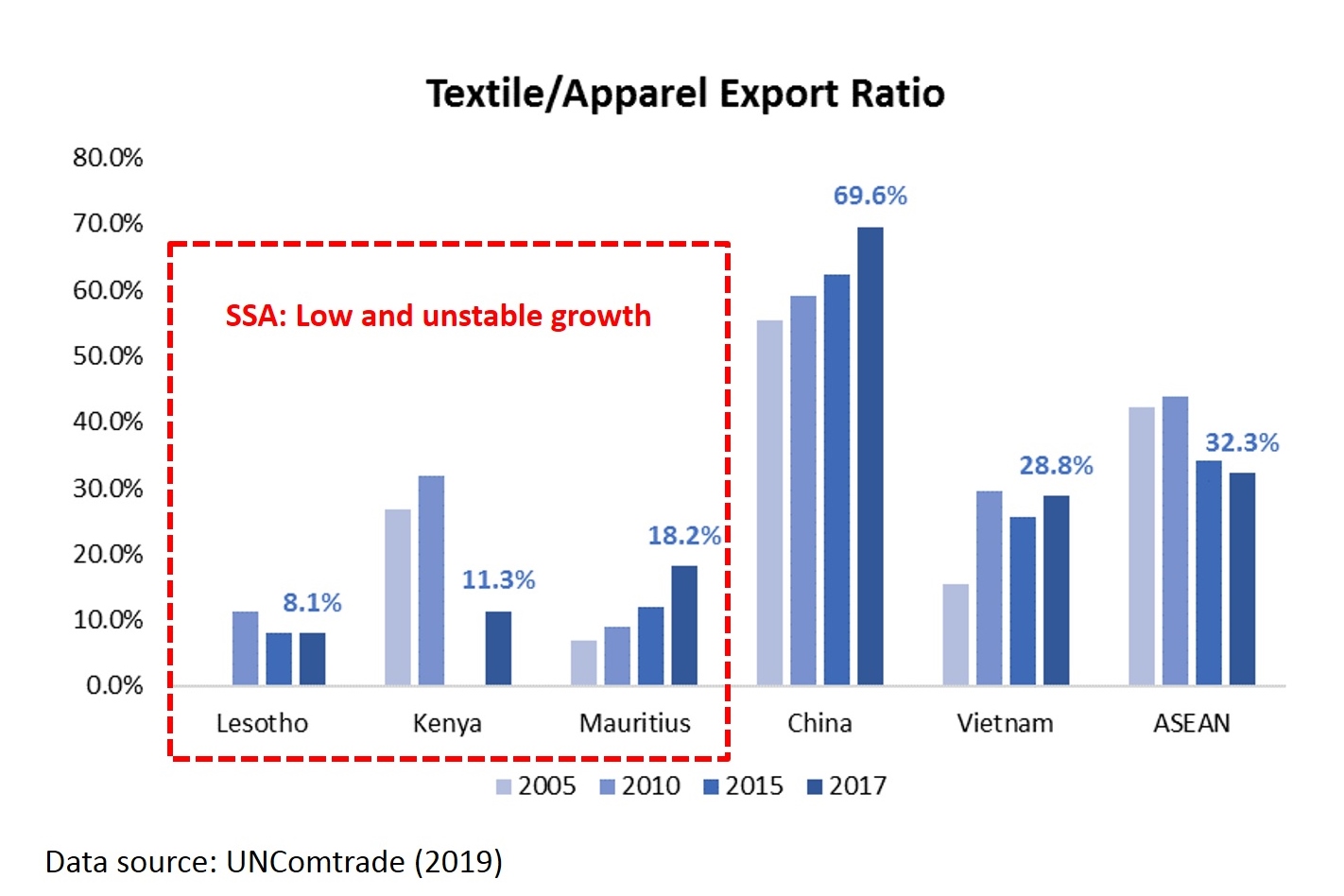
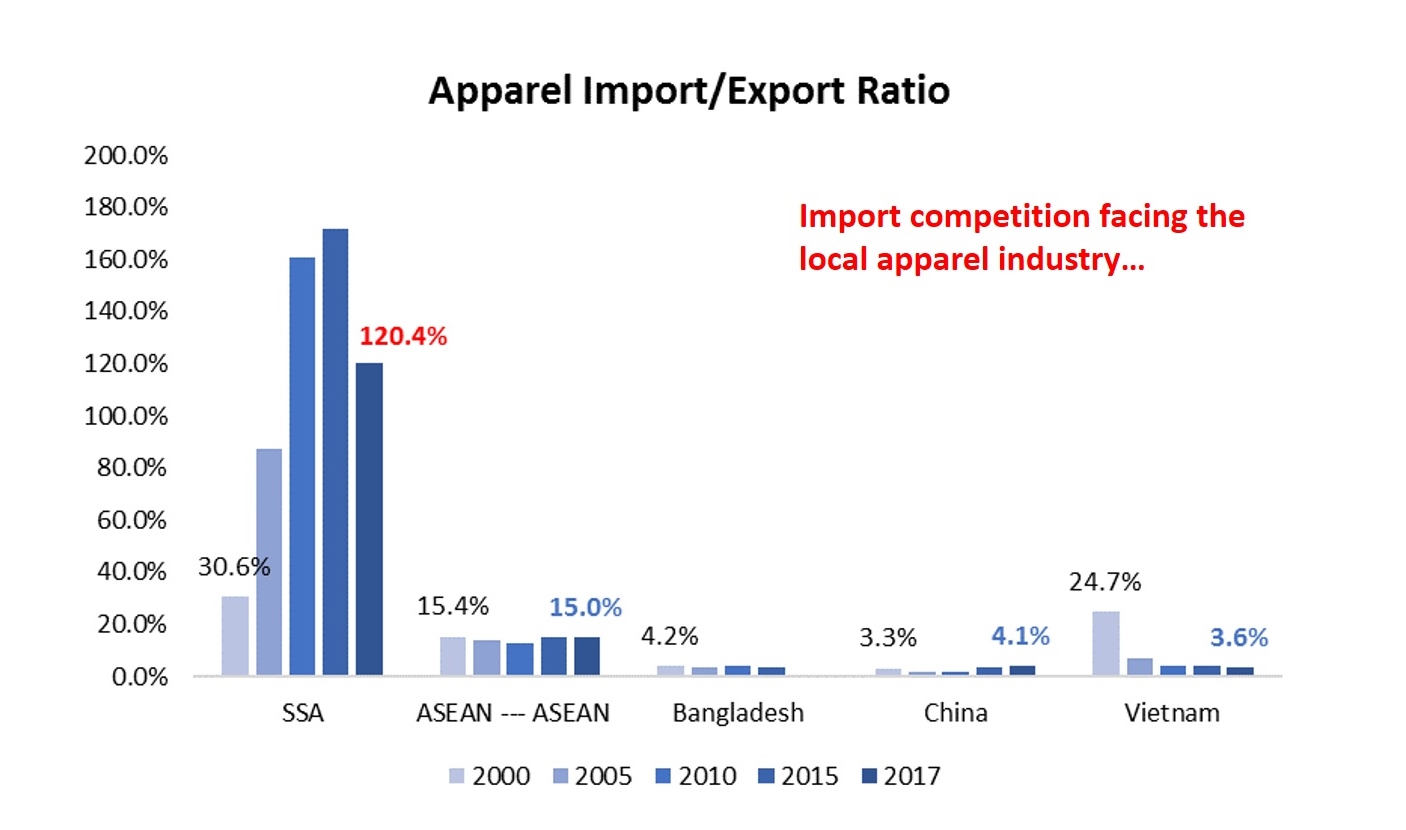
Theoretically, as a country’s economy advances, it should gradually be producing and exporting more capital and technology-intensive textiles versus labor-intensive apparel products. This is the notable trends in many Asian countries (such as China and Vietnam), where the textile/apparel export ratio has been rising steadily between 2005 and 2017. However, as a reflection of the stagnant industry upgrading, the textile/apparel export ratio remains fairly low in SSA, including in Lesotho, Kenya, and Mauritius, the top three largest apparel exporters in the SSA region.

2

Challenge 2: Slow and no progress in export diversification

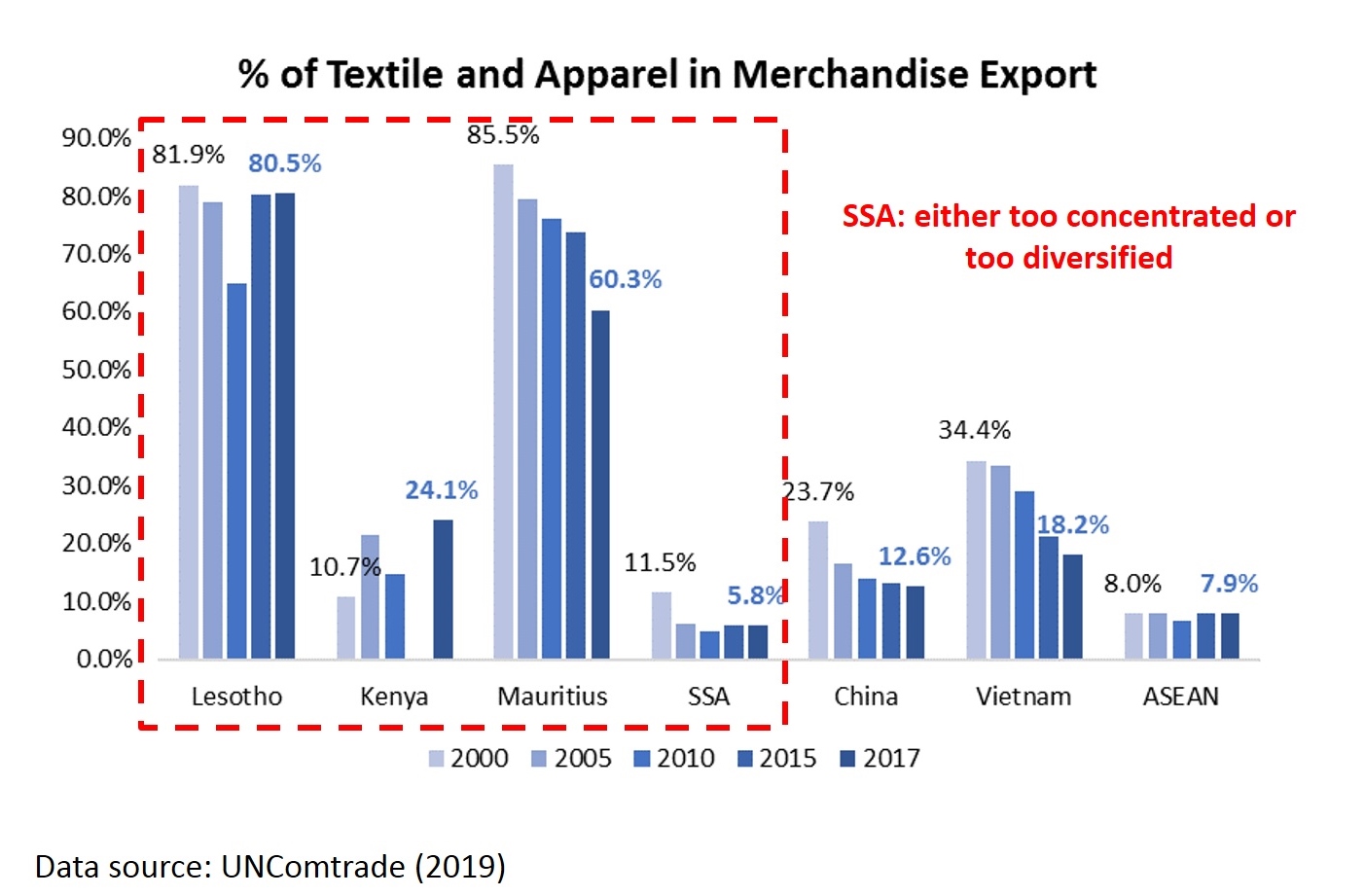
Ideally, as the economy becomes more sophisticated, textiles and apparel (T&A) should account for a declining share in a country’s total merchandise exports. Countries such as China, Vietnam, and ASEAN demonstrate perfect examples. However, in some SSA countries (e.g., Lesotho), T&A has stably accounted for over 80% of their total merchandise exports over the past 17 years, a sign of slow or no progress in export diversification. In other SSA countries, T&A accounted for less than 10% of their total merchandise exports, suggesting the sector is not a priority to the local economy.

3.jpg

4

Challenge 3: Intense competition both in key export markets and domestic market

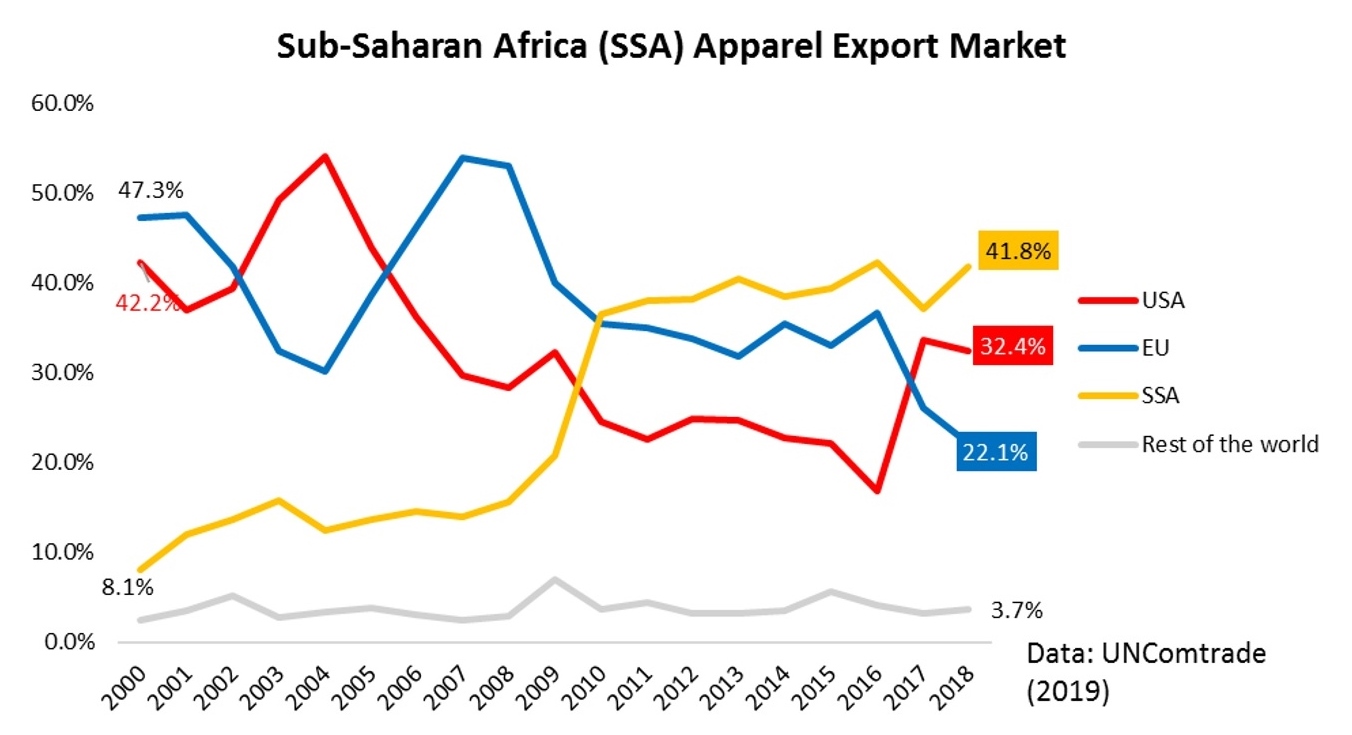
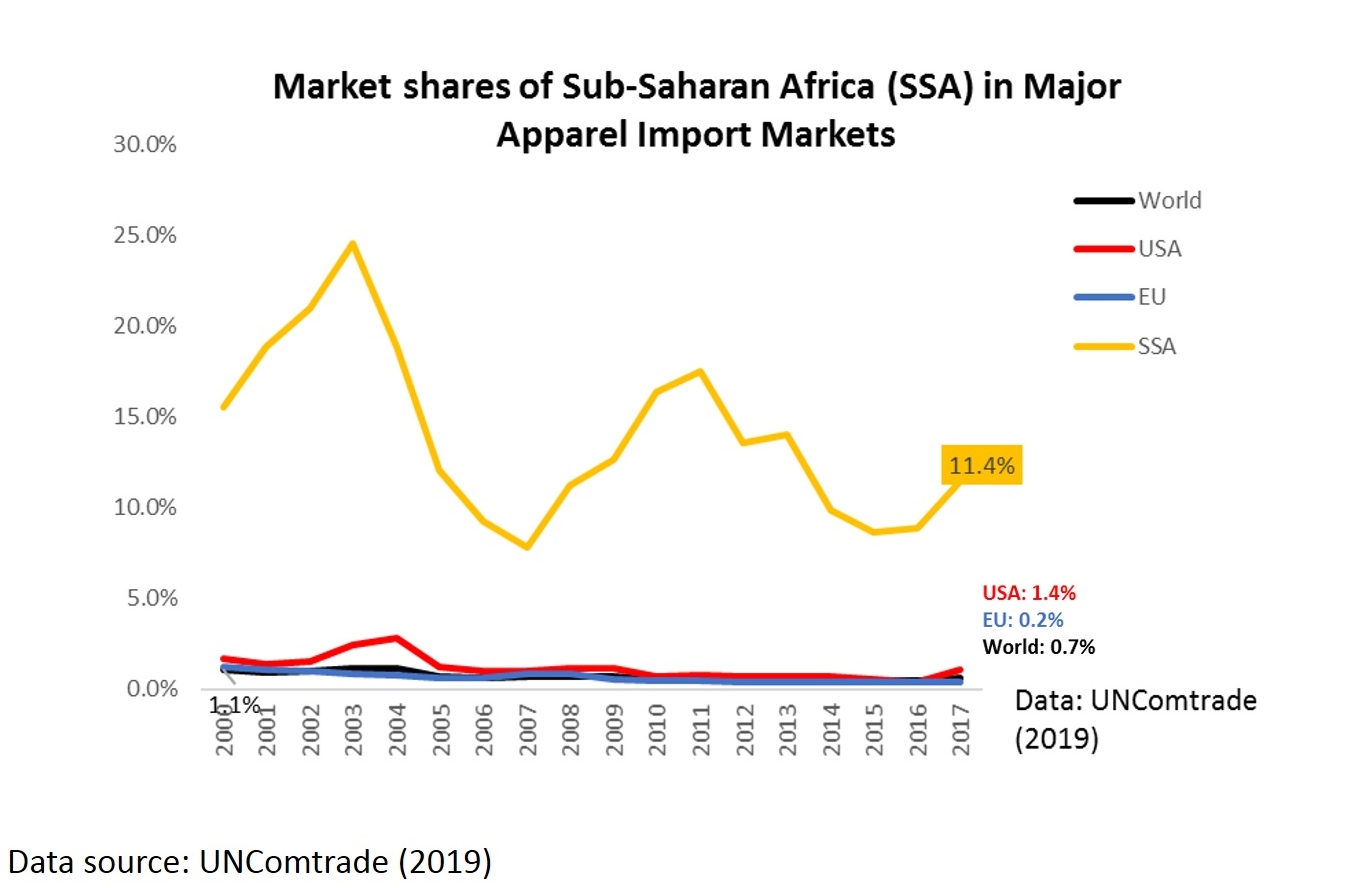
As of 2017, over 96% of SSA countries’ T&A exports went to three markets: the United States, the EU, and other SSA members. However, because of the intense competition, except for the regional SSA market, SSA countries account for merely 1.4% and 0.2% of total U.S. and EU textile and apparel imports in 2017 respectively.

5

Even more concerning, the T&A industry in SSA countries is facing growing competition in the domestic market with cheap imports, mostly from Asia. Notably, SSA countries import MORE apparel than they export, a phenomenon rarely seen among developing countries in a similar stage of economic development.

Challenge 4: U.S. companies remain low interest in investing in the region directly

According to several recent studies, leading U.S. fashion brands and retailers remain low interest in investing in the SSA region directly, even though companies admit more investments in areas such as infrastructure are critical to the success of SSA countries serving as competitive apparel sourcing bases. Some argue that the “temporary” nature of AGOA make companies hesitant to build factories in SSA. However, should AGOA become a permanent free trade agreement, which follows the principle of reciprocity, SSA countries would have to lower their trade barriers to U.S. products, including eliminating the tariffs and non-tariff barriers, in exchange for the reciprocal market access benefits from the United States. It doesn’t seem most AGOA members are ready for that stage yet.

by Sheng Lu

Further reading: Challenges for sub-Saharan Africa as an apparel sourcing hub

2019 U.S. Fashion Industry Benchmarking Study Released

The 2020 USFIA Fashion Industry Benchmarking Study is now available.


2019USFIA

The full report is available HERE

Key findings of this year’s report:

Impact of the U.S.-China tariff war on sourcing:  

  • The trade diversion effect of Section 301 has accelerated U.S. fashion companies’ pace of reducing sourcing from China. About 83 percent of respondents expect to decrease sourcing from China over the next two years, up further from 67 percent in 2018.
  • The Section 301 action is pushing up the price of U.S. apparel imports across the board, making “increasing production and sourcing cost” the top business challenge for respondents in 2019. As much as 63 percent of respondents explicitly say the U.S. Section 301 tariff action against China “increased my companies’ sourcing cost” in 2019. As companies are moving sourcing orders to Bangladesh, Vietnam, and India, the average price of U.S. apparel imports from these countries – the main alternatives to China — have all gone up by more than 20 percent in 2019 (January-May) year on year.
  • No evidence shows that Section 301 has benefited near-sourcing from the Western Hemisphere and reshoring from the United States significantly. Instead, respondents say Section 301 has increased the production costs of textiles and apparel “Made in the USA.”
  • Respondents say they are reluctant but may have to increase their retail prices, should the U.S.-China tariff war escalate further.

U.S. fashion companies’ latest sourcing strategy:

  • Most respondents maintain a relatively diverse sourcing base, with 57 percent currently sourcing from 10+ different countries or regions in 2019. Around 83 percent of respondents say they plan to source from the same number or more countries over the next two years. Asia as a whole continues to take the lead as the dominant sourcing base for U.S. fashion companies.
  • China plus Vietnam plus Many” is still the most popular sourcing model among respondents. However, its details are evolving. However, different from the past, China is no longer always the top supplier for U.S. fashion companies. Around 25 percent of respondents indicate that they source MORE from Vietnam than from China in 2019, an emerging trend important to watch.
  • This year, Vietnam remains the #2 sourcing destination among respondents, with a 86 percent usage rate. However, just around 7 percent of respondents plan to substantially increase apparel sourcing from Vietnam over the next two years, which reflects concerns about Vietnam’s limited production capacity and the increasing cost of sourcing from the country.
  • Bangladesh is the #6 top sourcing destination, with 60 percent usage among respondents. A record high percentage of respondents (80 percent) express interest in expanding sourcing from the country in the next two years. Despite the price advantages, however, respondents still see Bangladesh not as attractive as many of its competitors regarding speed to market, flexibility & agility, and risk of compliance.

Outlook for sourcing from China:

  • Despite the lingering tariff war, China will remain a dominant textile and apparel supplier for the U.S. market in the near future. Only 6.7 percent expect to decrease sourcing from the country significantly in the next two years.
  • China does not have a near competitor in terms of the variety of product it can make.
  • Considering speed to market, sourcing cost, flexibility & agility and compliance risk, China is also one of the few “balanced” sourcing destinations that U.S. fashion companies can choose from.
  • Around 50 percent of respondents further say their Chinese vendors “lowered their price to keep sourcing orders” in response to the trade tensions.

Reshoring and apparel “Made in the USA”:

  • This year, the United States ranked #10 top sourcing base with 43 percent usage, the same as in 2018.
  • “Made in the USA” apparel overall are treated as a niche product in U.S. fashion brands and retailers’ sourcing portfolio. The advantage of proximity to the market, which makes speedy replenishment for in-season items possible, is an important factor behind the more successful control of markdowns for “Made in the USA” products.
  • Respondents also list a few disadvantages and challenges that prevent them from sourcing more “Made in the USA” products in the next five years, ranging from the high price, limitations in the fabric options to a shortage of skilled labor.
  • Further, respondents say more information about U.S. based textile and apparel mills will be helpful to promote “Made in the USA” sourcing.

U.S.-Mexico-Canada Free Trade Agreement (USMCA):

  • The majority of respondents (65.5 percent) want the U.S. Congress to pass USMCA; More than half of respondents explicitly say NAFTA is important to their business and they want a seamless transition from NAFTA to USMCA.
  • S. fashion companies currently sourcing from the NAFTA region are more likely to use USMCA and vice versa.
  • However, a good proportion of respondents (around 20 percent) admit they do not fully understand the rule changes in USMCA for textiles and apparel.
  • Helping companies better understand the technical details of USMCA and reducing the uncertainty about its ratification will be essential to the future success of the agreement.

The US Fashion Industry Benchmarking Study from 2014 to 2018 can be downloaded HERE

U.S. Apparel Retailers’ Shifting Sourcing Strategy for “Made in China” under the Shadow of the Tariff War

The full article is available HERE

Key findings:

First, U.S. fashion brands and retailers are sourcing less from China, particularly in quantity. Notably, the number of “Made in China” apparel newly launched to the market had significantly dropped from 26,758 SKUs in the first quarter of 2018 to only 8,352 SKUs in the first quarter of 2019 . Nevertheless, consistent with the macro-level trade statistics, China remains the single largest apparel supplier to the U.S. retail market.

Second, apparel “Made in China” are becoming more expensive in the U.S. retail market, yet remain price-competitive overall. Notably, apparel “Made in Vietnam” is becoming more expensive in the U.S. retail market too—an indication that as more production is moving from China to Vietnam, apparel producers and exporters in Vietnam are facing growing cost pressures.

Third, U.S. fashion retailers are shifting what apparel products they source from China. U.S. apparel retailers have been sourcing less lower value-added basic fashion items (such as tops, and underwear), but more sophisticated and higher value-added apparel categories (such as dresses and outerwear) from China since 2018. The shifting product structure could also be a factor that contributed to the rising average retail price of “Made in China” in the U.S. market.

On the other hand, U.S. retailers adopt a very different product assortment strategy for apparel sourced from China versus other regions of the world. There seems to be much fewer alternative sourcing destinations for more sophisticated product categories, such as accessories and outerwear. Somehow ironically, moving to source more sophisticated and higher value-added products from China could make U.S. fashion brands and retailers even MORE vulnerable to the tariff war because of fewer alternative sourcing destinations.

In conclusion, the results imply that China will remain a critical sourcing destination for U.S. fashion brands and retailers in the near future, regardless of the scenario of the U.S.-China tariff war. Meanwhile, we should expect U.S. fashion companies continue to adjust their sourcing strategy for apparel “Made in China” in response to the escalation of the tariff war.

Related reading: Trade war to hit high-end US fashion brands dependent on specialized Chinese manufacturing

Trade 2030: The Future of World Trade


A group of eminent panelists will bring their experience on how digital technologies are changing international trade and how international trade cooperation can help governments reap the benefits and address the challenges of digital trade.

Speakers/Panalists:

  • Roberto Azevêdo, Director-General, World Trade Organization
  • Abdoullah Cisse, Professeur-Avocat, Carapaces Stratégies & Conformités
  • Caroline Freund, Director, Macroeconomics, Trade, and Investment Climate, World Bank
  • Susan Lund, Partner, McKinsey Global Institute

No-Deal Brexit: UK’s Import Tariff Rates for Apparel Products

The UK government on March 13, 2019 released the temporary rates of customs duty on imports if the country leaves the European Union with no deal. In the case of no-deal Brexit, these tariff rates will take effect on March 29, 2019 for up to 12 months.

According to the announced plan, around 87% of UK’s imports by value would be eligible for zero-tariff in the no-deal Brexit scenario.

Specifically for apparel products, 113 out of the total 148 tariff lines (8-digit HS code) in Chapter 61 (Knitted apparel) and 145 out of the total 194 tariff lines (8-digit HS code) in Chapter 62 (Woven apparel) will be duty-free. However, other apparel products will be subject to a Most-Favored-Nation (MFN) tariff rate ranging from 6.5% to 12%.

Meanwhile, the UK will offer preferential tariff duty rates for apparel exports from a few countries/programs, including Chile (zero tariff), EAS countries (zero tariff), Faroe Islands (zero tariff), GSP scheme (reduced tariff rate), Israel (zero tariff), Least Developed Countries (LDC) (zero tariff), Palestinian Authority (zero tariff), and Switzerland (zero tariff).

On the other hand, the EU Commission said it would apply the Most-Favored-Nation (MFN) tariff rates on UK’s products in the no-deal Brexit scenario rather than reciprocate.  

Appendix: UK’s MFN tariff rate for apparel products (HS Chapters 61-62) in the case of no-deal Brexit.

New CRS Report: Textile and Apparel Sectors Disagree on Certain Provisions of the Proposed U.S.-Mexico-Canada (USMCA) Agreement

The study is available HERE

Key findings:

While U.S. textile manufacturers and the apparel and retail industries have expressed overall support for the newly reached US-Mexico-Canada Free Trade Agreement (USMCA or NAFTA2.0), textile producers and the apparel sector still hold divergent views on certain provisions:

Textile “Yarn-Forward” Rule of Origin

USMCA vs. NAFTA1.0: The USMCA will continue to adopt the “yarn-forward” rules of origin. The USMCA will also newly require sewing thread, coated fabric, narrow elastic strips, and pocketing fabric used in apparel and other finished products to be made in a USMCA country to qualify for duty-free access to the United States.

U.S. textile industry: U.S. textile manufacturers almost always support a strict “yarn-forward” rules of origin in U.S free trade agreements and they support eliminating exceptions to the “yarn forward” rule as well. The National Council of Textile Organization (NCTO) estimates that a yearly USMCA market for sewing thread and pocketing fabric of more than $300 million.

U.S. apparel and retail industries: The U.S. apparel industry opposes “yarn forward” and argues that apparel should be considered of North American origin under a more flexible regional “cut and sew” standard, which would provide maximum flexibility for sourcing, including the use of foreign-made yarns and fabrics.

Tariff Preference Levels (TPL) for Textiles and Apparel

USMCA vs. NAFTA1.0: With some adjustments, the USMCA would continue a program that allows duty-free access for limited quantities of wool, cotton, and man-made fiber apparel made with yarn or fabric produced or obtained from outside the NAFTA region, including yarns and fabrics from China and other Asian suppliers.

U.S. textile industry: The textile industry contends China is a major beneficiary of the current NAFTA TPL mechanism, and it strongly pushed for its complete elimination in the USMCA.

U.S. apparel and retail industries: U.S. imports of textiles and apparel covered by the tariff preference level mechanism supply 13% of total U.S. textile and apparel imports from Canada and Mexico. Apparel producers assert that these exceptions give regional producers flexibility to use materials not widely produced in North America.

Viewpoints on other Provisions in USMCA

U.S. textile industry: The U.S. textile industry also opposes the USMCA newly allows visible lining fabric for tailored clothing could be sourced from China or other foreign suppliers, and it would permit up to 10% of a garment’s content, by weight, to come from outside the USMCA region (up from 7% in NAFTA1.0). The U.S. textile industry also welcomes that the USMCA would add specific textile verification and customs procedures aimed at preventing fraud and transshipment. Additionally, the U.S. textile industry is also pleased that the USMCA would end the Kissell Amendment. The Kissell Amendment is an exception in NAFTA that allows manufacturers from Canada and Mexico to qualify as “American” sources when Department of Homeland Security (DHS) buys textiles, clothing, and footwear using appropriated funds (about $30 million markets for textiles, clothing, and shoes altogether).

U.S. apparel and retail industries: Apparel importers are of concern that the USMCA continue to incorporate the existing NAFTA short supply procedure, which is extremely difficult to get a new item approved and added to the list, limiting their flexibility to source apparel with inputs from outside North America.

Finally, the report argues that “Regardless of whether the USMCA takes effect, the global competitiveness of U.S. textile producers and U.S.-headquartered apparel firms may depend more on their ability to compete against Asian producers than on the USMCA trade rules.

Related reading:

Cambodia May Lose Its Eligibility for European Union’s Everything But Arms (EBA) Program

Last week in FASH455, we discussed the unique critical role played by textile and apparel trade in generating economic growth in many developing countries. The developed countries also use trade policy tools, such as trade preference programs, to encourage the least developed countries (LDCs) making and exporting more apparel. However, a debate on these trade programs is that they have done little to improve the genuine competitiveness of LDCs’ apparel exports in the world marketplace, but instead have made LDCs rely heavily on these trade programs to continue their apparel exports. Here is one more example:

With growing concerns about “the deterioration of democracy, respect for human rights and the rule of law in Cambodia”, in a statement made on February 12, 2019, the European Union says it has started the process that could lead to a temporary suspension of Cambodia’s eligibility for EU’s Everything But Arms (EBA) program. Specifically, the EU process will include the following three stages:

  • Stage 1: six months of intensive monitoring and engagement with the Cambodian government;
  • Stage 2: another three months for the EU to produce a report based on the findings in stage 1
  • Stage 3: after a total of twelve months in stages 1 & 2, the EU Commission will conclude the procedure with a final decision on whether or not to withdraw tariff preferences; it is also at this stage that the Commission will decide the scope and duration of the withdrawal. Any withdrawal would come into effect after a further six-month period.

However, the EU Commission also stressed that launching the temporary withdrawal procedure does not entail an immediate removal of Cambodia’s preferential access to the EU market, which “would be the option of last resort.”

Developed in 2001, the EBA program establishes duty-free and quota-free treatment for all Least Developed Countries (LDCs) in the EU market. EBA includes almost all industries other than arms and armaments. As of February 2019, there are 49 EBA beneficiary countries.

The EBA program has benefited the apparel sector in particular given clothing accounts for the lion’s share in many LDCs’ total merchandise exports. Because of the preferential duty benefits provided by EBA, many LDCs can compete with other competitive apparel powerhouses such as China. Notably, the EBA program also adopts the “cut and sew” rules of origin for apparel, which is more general than the “double transformation” rules of origin typically required by EU free trade agreement and trade preference programs. Under the “cut and sew” rule, Cambodia’s apparel exports to the EU can enjoy the import duty-free treatment while using yarns and fabrics sourced from anywhere in the world.

Cambodia is a major apparel supplier for the EU market, accounting for approximately 4% of EU’s total apparel imports in 2017. Exporting apparel to EU through the EBA program is also of particular importance to Cambodia economically. In 2016, the apparel sector created over 500,000 jobs in Cambodia, of whom 86% were female, working in 556 registered factories. According to Eurostat, of EU’s €4.9bn imports from Cambodia in 2017, around 74.9% were apparel (HS chapters 61 and 62). Meanwhile, of EU’s €3.7bn apparel imports from Cambodia in 2017, as high as 96.6% claimed the EBA benefits. Understandably, losing the EBA eligibility could hurt Cambodia’s apparel exports to the EU significantly.

The Globotics Upheaval: Globalization, Robotics, and the Future of Work

Key points

  • “Globotics” or Globalization + Artificial intelligence (AI) is changing the world. Globotics means globalization mixed with new kinds of robotics, from artificial intelligence to technologies that make it easier to outsource services jobs. Particularly, globotics is injecting pressure into our socio-politico-economic system (via job displacement) faster than our system can absorb it (via job replacement). Overall, AI and robots will take jobs — but make the world better.
  • Past globalization and automation were mostly about goods— making them and shipping them. However, the era of globotics is about service-sector automation—driven by information and data.
  • The competition from software robots and telemigrants will seem monstrously unfair to white collar works who lost their jobs. When white-collar workers start sharing the same pain [as blue-collar workers], some sort of backlash is inevitable.
  • As technologies reduce the need for face-to-face contact, some developing nations stand to benefit. For example, India, with its sizeable English-speaking population and armies of techies, could become a hub for services outsourcing, just as China was for manufacturing.
  • Future jobs (that are left) will be more human and involve more face-to-face contact since software robots and tele-migrants will do everything else. In other words, the future economy will be more local and more human.
  • The problem is the short-term. In the era of globotics, it is important to make the rapid job displacement politically acceptable to a majority of voters. Governments may set the policy goal to protect workers, not jobs.

Trade Wars, Tariffs and Strategic Textile and Apparel Sourcing


Lenzing Texworld USA Winter 2019 Educational Series

Speaker: Gail Strickler, President of Global Trade Brookfield Associates, LLC & former Assistant U.S. Trade Representative for Textiles;

Topics covered:

  • The state of trade in textiles and apparel
  • Trans-Pacific Partnership (TPP)—what is now without the United States?
  • Latest on the U.S. Section 301 tariff against China
  • Updates on free trade agreements and textile and apparel (including USMCA, KORUS, US-EU FTA, CAFTA-DR, and AGOA)

Global Value Chain for Apparel Sold at Target

target cover

description

step 1

step 2

step 3

step 4

021313_moongate_assoc_global_value_chain_report1

A global view in mind means more career opportunities: except material production and cut and sew, other well-paid jobs in the apparel value chain stay in the United States.

Source: Moongate Association (2017). Analyzing the Value Chain for Apparel Designed in the United States and Manufactured Overseas

Demystify the “Made in the USA” Apparel Sourcing Strategy

While the majority of apparel consumed in the United States come from overseas, “Made in the USA” is growing in popularity. According to the 2018 U.S. Fashion Industry Benchmarking Study released by the U.S. Fashion Industry Association (USFIA) in July 2018, around 46 percent of surveyed U.S. fashion brands and apparel retailers report currently sourcing “Made in the USA” products, even though local sourcing typically only account for less than 10 percent of these companies’ total sourcing value or volume.  Likewise, the State of Fashion 2019 report published by Business of Fashion (BOF) and McKinsey & Company in November also forecasts that over 20 percent of U.S. fashion companies’ sourcing volume could be from nearshore by 2025, thanks to automation technology and consumers’ increasing demand for speed to market.

However, the detailed practice of the “Made in the USA” apparel sourcing strategy–including who is sourcing, what products are sourced, and what the typical price range of these products remain largely unknown.

To answer these questions, we recently analyzed the pricing, product assortment and inventory information of over 90,000 fashion retailers and 300,000,000 fashion apparel products at the Stock-Keeping Unit (SKU) level based on EDITED, a big data and business analytics tool developed for the fashion industry. For the research purpose, we selected apparel products newly launched to the U.S. market in the past twelve months (i.e., between 1 December 2017 and 30 November 2018) with “Made in the USA” explicitly mentioned in the product description. Below are the key findings:

First, “Made in the USA” apparel overall are treated as a niche product in U.S. fashion brands and retailers’ sourcing portfolio.

During the 12 months we examined (1 December 2017-30 November 2018), 94 out of the total 348 retailers (or 27 percent) sold “Made in the USA” apparel in the U.S. market. The top 10 sellers list includes BOTH retailers that focus on the value market such as Walmart and relatively high-end department stores such as Bloomingdale and Saks Fifth Avenue. However, even for these top sellers, “Made in the USA” apparel accounted for less than 8 percent of their total product offers on average.

Second, U.S. fashion brands and retailers are most likely to source“Made in the USA” apparel for relatively fashion-oriented items, particularly bottoms (such as skirts, jeans, and trousers), dresses, all-in-ones (such as playsuits and dungarees), swimwear and suits-sets.

The competitive edge for these product categories in the retail market, in general, increasingly depends on unique designs, high product quality, and speed to market, which makes sourcing from the United States commercially beneficial. In comparison, imported products are more concentrated on basic fashion items often competing on price in the U.S. retail market, including tops (such as T-shirt and polo shirt), underwear, and nightwear.

It is also interesting to note that “Made in the USA” apparel were predominately women’s wear (92 percent), whereas imported clothing adopted a more balanced gender combination (63 percent women’s wear and 37 percent men’s wear). Because the fashion trends for women’s wear usually are shorter-lived and harder to predict, this result once again indicates that seeking quick response and shorter lead time for stylish and trendy items could be an important incentive for local sourcing by U.S. fashion brands and retailers.

Third, consistent with the common perception, “Made in the USA” apparel overall are pricier than imported ones in the U.S. retail market.

Taking the U.S. apparel retail market as a whole, close to 40 percent of “Made in the USA” offering in the past 12 months targeted the premium or luxury market, compared with only 20 percent of imported products.  In contrast, as few as 18 percent of “Made in the USA” offering were in the value market, which, however, accounted for approximately 60 percent of all imported apparel sold in the U.S. market. In totality, it seems U.S. fashion brands and retailers are purposefully targeting “Made in the USA” apparel for less price-sensitive segments of the market to balance the high domestic production cost.

On the other hand, when examining U.S. fashion brands and retailers’ pricing strategy at the product level, “Made in the USA” clothing was still priced much higher than imported ones for almost all major apparel categories, except hosiery. Notably, in the past 12 months, the average unit retail price of “Made in the USA” clothing was 99.2 percent higher than imported ones in the value and mass market and 36.0 percent higher in the premium and luxury market. This interesting phenomenon supports the arguments that U.S. consumers somehow are willing to pay a premium price for products with the “Made in the USA” label.  

Additionally, during the past 12 months, around 46.3 percent of “Made in the USA” apparel were sold at a discount compared with more than 54.6 percent of imported ones. The advantage of proximity to the market, which makes speedy replenishment for in-season items possible, is an important factor behind the more successful control of markdowns for “Made in the USA” products. For example, data shows that U.S. fashion brands and retailers replenished approximately 12.7 percent of their “Made in the USA” offering in the past 12 months but only 2.8 percent of imported clothing.

In conclusion, the findings of this study concur with the view that “Made in the USA” apparel are still relevant today. Meanwhile, it does not seem to be the case that “Made in the USA” apparel and imported ones are necessarily competing with each other in the U.S. retail market. With apparel sourcing increasingly requiring striking a balance among various factors ranging from cost, flexibility, compliance to speed to market, it is hopeful that “Made in the USA” apparel will continue to have its unique role to play in U.S. fashion brands and retailers’ merchandising and sourcing strategies.

By Sheng Lu

Outlook 2019: Apparel Industry Issues in the Year Ahead

In January 2019, Just-Style consulted a panel of industry leaders and scholars in its Outlook 2019–Apparel Industry Issues in the Year Ahead management briefing. Below is my contribution to the report. Any comments and suggestions are more than welcome!

1: What do you see as the biggest challenges – and opportunities – facing the apparel industry in 2019, and why?

In my view, uncertainty will remain the single biggest challenge facing the apparel industry in 2019, ranging from a more volatile global economy, the unpredictable outlook of the U.S.-China trade talks to the various possible scenarios of Brexit. While uncertainty creates exciting new research opportunities for scholars like me, it could be a big headache for companies seeking a foreseeable market environment to guide their future business plan and investments. 

Meanwhile, the increasing digitalization of the apparel supply chain based on big-data tools and artificial intelligence (AI) technologies means a huge opportunity for fashion companies. Indeed, the apparel industry is quickly changing in nature—becoming ever more globalized, supply-chain based, technology-intensive and data-driven. Take talent recruitment as an example. In the 2018 US Fashion Industry Benchmarking Study, which I conducted in collaboration with the US Fashion Industry Association (USFIA), as much as 68 percent of surveyed leading U.S. fashion brands and apparel retailers say they plan to increase hiring of data scientists in the next five years. Googling “apparel industry” together with terms such as “big data” and “data science” also returns much more results than in the past. It is hopeful that the advancement of digital technologies and the smarter use of data will enable apparel companies to overcome market uncertainties better and improve many aspects of their businesses such as speed to market, operational efficiency and even sustainability.

2: What’s happening with sourcing? How is the sourcing landscape likely to shift in 2019, and what can apparel firms and their suppliers do to stay ahead?

Based on my research, I have three observations regarding apparel companies’ sourcing trends and the overall sourcing landscape in 2019:

First, apparel companies overall will continue to maintain a diverse sourcing base. For example, in a recent study, we examined the detailed sourcing portfolios of the 50 largest U.S.-based apparel companies ranked by the Apparel Magazine. Notably, on average these companies sourced from over 20 different countries or regions using more than 200 vendors in 2017. Similarly, in the 2018 US Fashion Industry Benchmarking Study, which I conducted in collaboration with the US Fashion Industry Association (USFIA), we also found companies with more than 1,000 employees typically source from more than ten different countries and regions. Since no sourcing destination is perfect, maintaining a relatively diverse sourcing base allows apparel companies to strike a balance among various sourcing factors ranging from cost, speed, flexibility, to risk management.

Second, while apparel companies are actively seeking new sourcing bases, many of them are reducing either the number of countries they source from or the number of vendors they work with. According to our study, some apparel companies have been strategically reducing the number of sourcing facilities with the purpose of ensuring closer collaborations with their suppliers on social and environmental compliance issues. Some other companies are consolidating their sourcing base within certain regions to improve efficiency and maximize productivity in the supply chain. Related to this trend, it is interesting to note that approximately half of the 50 largest U.S. apparel companies report allocating more sourcing orders to their largest vendor in 2017 than three years ago.

Third, nearshoring or onshoring will become more visible. Take “Made in the USA” apparel for example. According to the 2018 U.S. Fashion Industry Benchmarking Study, around 46 percent of surveyed U.S. fashion brands and apparel retailers report currently sourcing “Made in the USA” products, even though local sourcing typically only account for less than 10 percent of these companies’ total sourcing value or volume. In a recent study, we find that 94 out of the total 348 retailers (or 27 percent) sold “Made in the USA” apparel in the U.S. market between December 2017 and November 2018. These “Made in the USA” apparel items, in general, focus on fashion-oriented women’s wear, particularly in the categories of bottoms (such as skirts, jeans, and trousers), dresses, all-in-ones (such as playsuits and dungarees), swimwear and suits-sets. The advantage of proximity to the market, which makes speedy replenishment for in-season items possible, also allows retailers to price “Made in the USA” apparel substantially higher than imported ones and avoid offering deep discounts. Looking ahead, thanks to automation technology and consumers’ increasing demand for speed to market, I think nearshoring or onshoring, including ”Made in the USA” apparel, will continue to have its unique role to play in fashion brands and retailers’ merchandising and sourcing strategies.

3: What should apparel firms and their suppliers be doing now if they want to remain competitive further into the future? What will separate the winners from the losers?

2019 will be a year to test apparel companies’ resources, particularly in the sourcing area. For example, winners will be those companies that have built a sophisticated but nimble global sourcing network that can handle market uncertainties effectively. Likewise, companies that understand and leverage the evolving “rules of the game”, such as the apparel-specific rules of origin and tariff phase-out schedules of existing or newly-reached free trade agreements, will be able to control sourcing cost better and achieve higher profit margins. Given the heavy involvement of trade policy in apparel sourcing this year, companies with solid government relations should also enjoy unique competitive advantages. 

On the other hand, as apparel business is changing in nature, to stay competitive, apparel companies need to start investing the future. This includes but not limited to exploring new sourcing destinations, studying the changing consumer demographics, recruiting new talents with expertise in emerging areas, and adopting new technologies fitting for the digital age. 

4: What keeps you awake at night? Is there anything else you think the apparel industry should be keeping a close eye on in the year ahead? Do you expect 2019 to be better than 2018, and why?

Two things are at the top of my watchlist:

First, what is the future of China as an apparel sourcing base? While external factors such as the U.S.-China tariff war have attracted most of the public attention, the genuine evolution of China’s textile and apparel industry is something even more critical to watch in the long run. From my observation, China is playing an increasingly important role as a textile supplier for apparel-exporting countries in Asia. For example, measured by value, 47 percent of Bangladesh’s textile imports came from China in 2017, up from 39 percent in 2005. Similar trends are seen in Cambodia (up from 30 percent to 65 percent), Vietnam (up from 23 percent to 50 percent), Pakistan (up from 32 percent to 71 percent), Malaysia (up from 25 percent to 54 percent), Indonesia (up from 28 percent to 46 percent), Philippines (up from 19 percent to 41 percent) and Sri Lanka (up from 15 percent to 39 percent) over the same time frame. A key question in my mind is how quickly China’s textile and apparel industry will continue to evolve and upgrade by following the paths of most other advanced economies in history.

Second, how will the implementation of several newly-reached free trade agreements (FTAs) affect the big landscape of apparel sourcing and the existing regional apparel supply chains? For example:

  • The newly-reached U.S.-Mexico-Canada Free Trade Agreement (USMCA or commonly called NAFTA2.0) includes several interesting changes to the textile and apparel specific rules of origin provisions, such as the adjustment of the tariff-preference level (TPL) mechanism. Whether these changes will boost textile and apparel production in the Western-Hemisphere and attract more sourcing from the region will be something interesting to watch.
  • The implementation of the Comprehensive and Progressive Agreement of the Trans-Pacific Partnership (CPTPP) and the EU-Vietnam Free Trade Agreement (EVFTA) will allow Vietnam to get access to nearly 40% of the world apparel import market (i.e., EU + Japan) duty-free. However, restrained by the country’s relatively small population, the apparel industry is increasingly facing the challenge of competing for labor with other export-oriented sectors in Vietnam. Realistically, what is the growth potential of apparel “Made in Vietnam” after the implementation of CPTPP and EVFTA?
  • In 2017, close to 80% of Asian countries’ textile imports came from other Asian countries, up from around 70% in the 2000s. Similarly, in 2017, 85.6% of Asian countries’ apparel imports also came from within the region. The negotiation of the Regional Comprehensive and Economic Partnership (RCEP) is likely to conclude in 2019, whose membership includes member states of the Association of Southeast Asian Nations (ASEAN) and other six economies in the Asia-Pacific region (Australia, China, India, Japan, South Korea and New Zealand). Will RCEP result in an ever more integrated Asia-based textile and apparel supply chain and make the Asia region even more competitive as an apparel sourcing destination?  

(comment for this post is closed)

Textile and Apparel and the Proposed U.S.-EU Free Trade Agreement

I. Background

On October 16, 2018, the Trump Administration notified U.S. Congress its intention to negotiate the U.S.-EU Free Trade Agreement. Between 2013 and 2016, the United States and EU were also engaged in the negotiation of a comprehensive free trade agreement– Trans-Atlantic Trade and Investment Partnership (T-TIP) with the goal to unlock market access opportunities for businesses on both sides of the Atlantic through the ambitious elimination of trade and investment barriers as well as enhanced regulatory coherence. The T-TIP negotiation was stalled since 2017, although the Trump Administration has never officially announced to withdraw from the agreement.   

II. Negotiating Objectives

On January 11, 2019, the Office of the U.S. Trade Representative (USTR) released the negotiating objectives of the proposed U.S.-EU Free Trade Agreement after seeking inputs from the public. Overall, the proposed agreement aims to address both tariff and non-tariff barriers and to “achieve fairer, more balanced trade” between the two sides.

Regarding textiles and apparel, USTR says it will secure duty-free access for U.S. textile and apparel products and seek to improve competitive opportunities for exports of U.S. textile and apparel products while taking into account U.S. import sensitivities” during the negotiation. The proposed U.S.-EU free trade agreement also will “establish origin procedures for the certification and verification of rules of origin that promote strong enforcement, including with respect to textiles.” T-TIP had adopted similar negotiating objectives for the textile and apparel sector.

III. Industry viewpoints on the agreement

As of January 2019, leading trade associations representing the U.S. apparel industry and the EU textile and apparel industries have expressed support for the proposed U.S.-EU Free Trade Agreement. In general, these industry associations recommend the agreement to achieve the following goals:

First, eliminate import duties. For example:

American Apparel and Footwear Association (AAFA): “We support the immediate and reciprocal elimination of the high duties that both countries maintain on textiles, travel goods, footwear, and apparel.”…” We also support the immediate elimination of any retaliatory duties imposed by the E.U., as well as any duties imposed by the U.S. (that led to that retaliation). The duties impose costs on activities, including manufacturing activities in the U.S., and undermine markets for U.S. exporters in Europe.”

European Apparel and Textile Confederation (Euratex): “The European Textile and Clothing sector faces high tariffs while exporting to the US market from 11% to up to 32% for some products, namely sewing thread of man-made filaments, suits, woven fabrics of cotton, trousers and t-shirts. Zero customs duties while ensuring modern rules of origin will allow EU companies to boost exports and offer more choice to American consumers and professional buyers.”
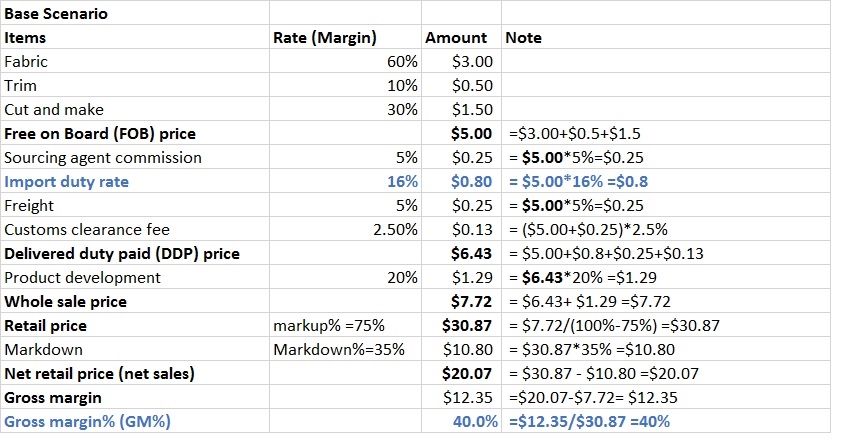
Second, promote regulatory coherence (Harmonization). For example:

AAFA: “The E.U. and the United States both maintain an extensive array of product safety, chemical management, and labeling requirements regarding apparel (including legwear), footwear, textiles, and travel goods.”…” Yet they often contain different requirements, such as testing or certification, that greatly add compliance costs.”…” We believe the U.S.‐E.U. trade agreement presents an important opportunity to achieve harmonization or alignment for these regulations.”

Euratex: “Maintaining high level of standards while eliminating unnecessary burdens, removing additional requirements and facilitating customs procedures that impede business are top priorities. Mutual recognition of the EU and US standards will preserve high level of consumer protection on both sides of the Atlantic. Convergence on labelling (fibre names, care symbols and wool labelling), consumer safety on children products and flammability standards is key for the T&C sector.” “EURATEX believes the EU and US standardization bodies should cooperate on setting standards for Smart Textiles taking into account the industry views for facilitating development and trade of such products of the future.”

Third, adopt flexible/modern rules of origin. For example:

AAFA: “We should also support higher usage of the agreement by making sure the rules of origin reflect the realities of the industry today…”the yarn forward” rules, although theoretically promote usage of trade partner inputs, in practice they operate as significant barriers that restrict the ability of companies to use a trade agreement in many cases”…” We need to incorporate sufficient flexibilities into the rules of origin so that different supply chains –and the U.S. jobs they support – can take advantage of the agreement.”

Euratex: “Zero customs duties while ensuring modern rules of origin will allow EU companies to boost exports and offer more choice to American consumers and professional buyers.”

The National Council of Textile Organizations (NCTO), which represents the U.S. textile industry, hasn’t publically stated its position on the proposed U.S.-EU Free Trade Agreement. However, NCTO had strongly urged U.S. trade negotiators to adopt a yarn-forward rule of origin in T-TIP. NCTO also opposed opening the U.S. government procurement market protected by the Berry Amendment to EU companies.

IV. Patterns of U.S.-EU textile and apparel trade

The United States and the EU are mutually important textile and apparel (T&A) trading partners. For example, the United States is EU’s largest extra-region export market for textiles, and EU’s fifth largest extra-region supplier of textiles in 2017 (Euratex, 2018).

Meanwhile, the EU is one of the leading export markets for U.S.-made technical textiles as well as an important source of high-end apparel products for U.S. consumers (OTEXA, 2018). Specifically, in 2017, U.S. T&A exports to the European Union totaled $2,572 million, of which 73.2% were textile products, such as specialty & industrial fabrics, felts & other non-woven fabrics and filament yarns. In comparison, EU’s T&A exports to the United States totaled $4,163 million in 2017, among which textiles and apparel evenly accounted for 48.7% and 51.3% respectively.

V. Potential economic impact of the agreement

By adopting the Global Trade Analysis Project (GTAP) model, Lu (2017) quantitatively evaluated the potential impact of a free trade agreement between the U.S. and EU on the textile and apparel sector. According to the study:

First, the trade creation effect of the agreement will expand the EU-U.S. intra-industry trade for textiles. Meanwhile, the agreement is likely to significantly expand EU’s apparel exports to the United States.

Second, the trade diversion effect of the U.S.-EU Free Trade Agreement will affect other T&A exporters negatively, including Asia’s T&A exports to the U.S. market and EU and Turkey’s T&A exports to the EU market.

Third, the U.S.-EU Textile and Apparel Trade might affect the intra-region T&A trade in the EU region negatively but in a limited way.

Overall, the study suggests that the EU T&A industry will benefit from the additional market access opportunities created by the U.S.-EU Free Trade Agreement. One important factor is that the U.S. and EU T&A industries do not constitute a major competing relationship. For example, the United States is no longer a major apparel producer, and EU’s apparel exports to the United States fulfill U.S. consumers’ demand for high-end luxury products. The U.S.-EU Free Trade Agreement is also likely to create additional export opportunities for EU textile companies in the U.S. market, especially in the technical textiles area, which accounted for approximately 40% of EU’s total textile exports to the United States in 2017 measured in value. Compared with traditional yarns and fabrics for apparel making purposes, technical textiles are with a greater variety in usage, which allows EU companies to be able to differentiate products and find their niche in the U.S. market.

Further, the study suggests that we shall pay more attention to the details of non-tariff barrier removal under the U.S.-EU Free Trade Agreement, which could result in bigger economic impacts than tariff elimination. 

Recommended reading:
Lu, S. (2017). Trans-Atlantic Trade and Investment Partnership: An Opportunity or a Threat to the EU Textile and Apparel Industry? Journal of the Textile Institute, 109 (7), 933-941.